|
|
Law No.1 (The Paradox of the Fisks): The most criticised societies in the world will be the least criminal societies.
Journalists prefer assignments in civilized countries Western journalists in dictatorships tend to be anti-western Law No.2 (The Paradox of Cruelty): The greater the hatred, the less the reason. Law No.3 (Corollary): All great suffering is always for worthless causes. Ahlam Tamimi - the smiling face of evil. Law No.4 (The Law of Protests): Protests and demos do not represent public opinion.
|
|
The western media
Why do people support the Palestinians?
|
It is not so widely recognised that people's political beliefs, as well as their religious beliefs, are dominated by meme competition, rather than by reason and logic. Here's a couple of laws that I see as holding true on this planet.
Why is this?
The killing of a dozen protesters in a foreign closed society might rate one paragraph, one time. The killing of a dozen protesters in the free society would completely dominate news and analysis for months, and be strongly covered for years afterwards, even decades afterwards. There are all sorts of good reasons for why this is so. But the fact is, it is so. I am simply pointing out that the coverage is not equal.
Of course, in a free society the killing of protesters is a rare event. But even minor crimes - like bribery or lying to parliament - can dominate the news for months. While actual massacres in foreign closed societies may be covered in "World News in Brief".
I am simply pointing out the obvious that minor crimes (bribery, embezzlement, lying to parliament) in the free world usually receive more column inches than major crimes (state repression, torture, executions) in the unfree world. There are good reasons for why this is so. But the fact is, it is so. The end result is that in the free press, the column inches given to criticism of free societies will be vastly greater than the column inches given to criticism of closed societies.
The societies singled out to be criticised are by definition those that are best-behaved. What did these societies do to be singled out for criticism? They were not ruthless enough. If they were ruthless, brutal and unfree, they would not be criticised so much. It is because their crimes are modest that they get criticised more.
And so we have a whole generation of journalists and polemicists like Robert Fisk and John Pilger, who write almost entirely about the crimes of the least criminal societies.
In the closed society, the regime (happily) reprints the free society's criticisms of itself. No criticisms are printed of the closed society. Many people in the closed society, not knowing anything else, may even come to believe that the free society is more flawed than the closed society. For example, in the Arab Middle East, most criticism seems to be of Israel and America, rather than of their own societies, which are far more flawed.
And in the free society, naive young people read the criticisms of the free society, and don't read the (small) criticisms of (uninteresting) foreign closed societies. They too may even come to believe that the free societies are the worst societies. And so we see a thousand marches and protests against America, Israel and Britain in the west, while I personally cannot ever remember a single major protest against the Soviet Union, China, Iraq, North Korea, North Vietnam, Serbia, the Sudan or any of recent history's serious criminals.
Similarly, I have seen in my life an endless series of posters, banners, graffiti and cartoons comparing the free countries of America, Israel and Britain to Nazi Germany, and their leaders to Hitler. I'm not sure I have ever seen this about an unfree country.
By definition, the countries people protest about are the best countries. They get this abuse because they are not ruthless enough. If they really were imperialists and mass killers (like the Soviet Union), no one would protest about them.

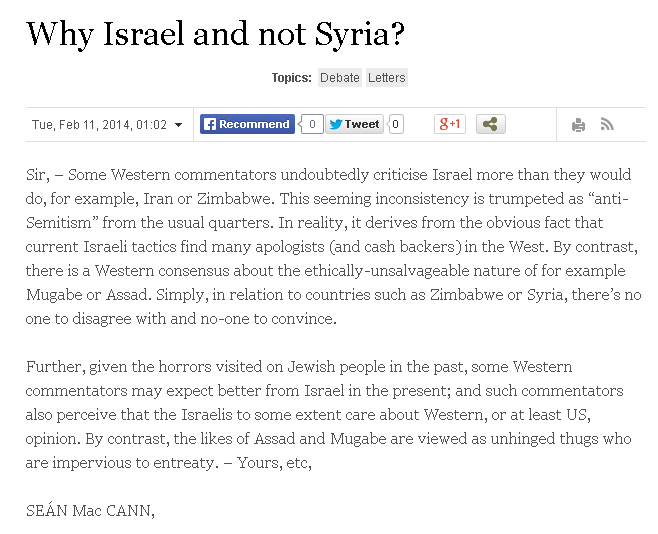
A letter in the Irish Times,
11 Feb 2014,
makes my point for me.
Israel is criticised more than the really bad countries because:
In places like Syria, Somalia, Congo or Afghanistan, journalists have poor facilities, lack of comfort, and always have to worry about the secret police or local warlords.
Result: Far more reporting about Israel and its minor wars than reporting about major wars in less pleasant places.
To get all this negative coverage, Israel's crime was to be comfortable and nice to journalists. If Israel threatened journalists with death, it would get far less negative coverage, not more.
Hence you have people like Robert Fisk reporting from Lebanon and Syria - because no pro-western, pro-Israel journalist would be safe there.
And you have people like Michael Jansen reporting from Gaza - because no pro-Israel journalist would be safe there.
Hence I cannot visit Gaza. But lefties can.
Western readers think "Our correspondent from X" speaks objectively. But of course it is only "Our correspondent that has opinions that allow them live safely in X". So X forces the western reader to only hear a certain type of voice.
Unfree regimes are able to get their message out, by filtering out of the western media any journalists who will be too critical of them.
Again, there is this belief that humans must be rational. This is expressed in the question: "Why do they hate us?", which assumes there is an answer. Their hatred must surely be founded on reason. It couldn't just be founded on memes could it?
Yes it could, of course. It is not true that people must hate for a reason. Sometimes people hate for a reason that is somehow grounded in reality. But people can hate for no reason at all, or at least, no reason that makes any sense.
Humans kill for no reason. Humans die for no reason. They always have, and they always will. Obviously, there are "reasons" of sorts in their crazy, addled brains. What I am saying is that history shows us those "reasons" can be junk - hallucinations, lies, inner demons. That's my bleak view of religion and politics and human nature.
Germany rounded up 6 million Jews - men, women, children, crying toddlers, babies - and shot them in pits and gassed them in camps in scenes from hell. Yet what did the Jews ever do to Germany to deserve being hated? Hitler's complaints about the Jews are fantastical, imaginary, hallucinatory, and simply pathetic compared to the unbelievable violence he carried out against them.
The Jews of Old Europe were the ultimate innocents. There was no reason whatsoever for the hatred against them. And so they were the recipients of the most staggering violence.
One could say the same about the "kulaks" who were exterminated by Lenin, Trotsky and Stalin. What did these poor peasants do to be hated so? The answer, of course, is nothing. Nothing at all. It is the same with the "bourgeoisie" who were butchered by the hate-filled killers Mao and Pol Pot. What did these ordinary families ever do to cause such staggering hatred and violence against them? Again, nothing.
What did the "witches" do to deserve being burnt alive by the thousand in the Middle Ages? What did the Armenians do to be hated so much and slaughtered by the Turks? What did the Asians do to be driven out of Uganda? Basically, nothing. Massive hate does not have to have a good reason. In fact, it basically never does.
The greatest hatred, killing and cruelty in human history has always been against the innocent, not the guilty. Truly unrestrained hatred is always against the innocent.
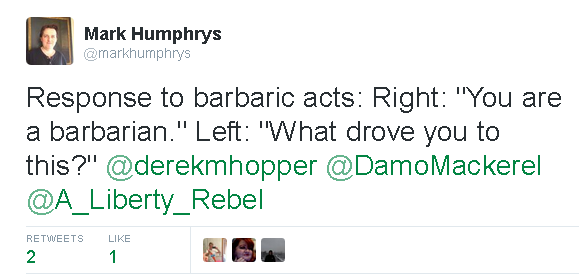
This law would imply that all really great, monumental suffering is always for nothing.
There have been more worthwhile causes in history - the fight by the west for democracy and human rights. The west had far more reason to hate, and to kill. And yet the killing by the west was more restrained, not less. Truly unrestrained killing is always in pursuit of a cause that is worthless.
And indeed their cause did turn out to be worthless. Their cause is imaginary, based on dreams of ending the west and restoring some kind of 7th century utopia that nobody wants. All that killing for nothing.
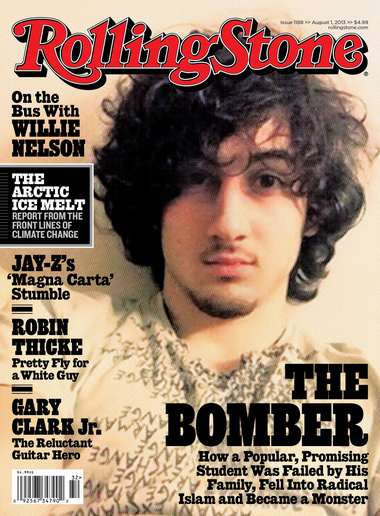
This is the norm in human history. The people who carry out genocides and atrocities like Sept 11th are not rational people. It would be very surprising if their complaints actually had any basis in reality. It would be simply incredible if their causes were actually worthwhile.

The handsome face of genocide denial.
This is
Ahmad
of the conspiracy account
Propaganda & Co.
Here he is
denying the genocidal Hamas attack on Israeli innocents on 7 October 2023.
Multiple people
(see here
and here)
say this guy is Ahmad Saadaldin.
He certainly looks like him.
Genocide deniers are not ugly old men.
They are young and handsome,
but filled with the same hatred.
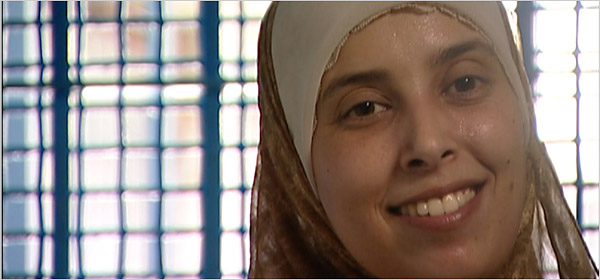
The smiling face of evil.
This pleasant-looking young woman,
Ahlam Tamimi,
helped burn children alive
in the
Sbarro pizzeria
in 2001.
And they were not collateral damage. They were the target.
And she says:
"I'm not sorry for what I did."
Photo from here.
Disgusting:
This modern day
"Bitch of Buchenwald"
is released in Oct 2011 in part exchange for Gilad Shalit.
The satanic witch smiles when she hears that she killed 8 children.
Governments however, being more sensible than journalists, do frequently completely ignore demos as if they had never happened. Governments realise that demos are simply another form of speech, no different to (apart from being ruder and more aggressive) and no more privileged than the usual collection of various points of view one can find in blogs, newsgroups or letters to the paper.
One fact governments understand instinctively: Demos do not represent public opinion:
Even huge demos may not represent public opinion. Votes represent public opinion. Demos don't.
People who have serious jobs, mortgages, babies and children to care for, perhaps elderly parents to care for, and so on - not to mention having tired, middle-aged bodies exhausted by their reponsibilities - will not be found on demos, or travelling round the country living in tents and engaging in "direct action". They have opinions just as strong as the carefree, childless students, but they will not express them at demos. They express them at the ballot box. Governments know this, and that is why they do not take demos seriously.
"END THE OCCUPATION OF PALESTINE. PUBLIC MEETING ..." say the posters. Why does one never see posters saying: "STOP SUICIDE BOMBINGS. PUBLIC MEETING ..."? It is not because nobody subscribes to that view. It is because only certain types of people go round putting up posters and having public meetings. Posters do not represent public opinion, and should not be taken seriously.
Similarly, "NO WAR" and "DON'T ATTACK IRAQ" reads the graffiti. Why does one never see graffiti saying: "BRING DEMOCRACY TO THE MIDDLE EAST" or "END ISLAMIC LAW"? Again, it is because only certain types of people spray graffiti. Graffiti does not represent public opinion, and should not be taken seriously.
"How come,"
I asked Andy,
"whenever something upsets the Left, you see immediate marches and parades and
rallies with signs already printed and rhyming slogans already composed, whereas whenever something upsets the
Right, you see two members of the Young Americans for Freedom waving a six-inch American flag?"
"We have jobs,"
said Andy.
- Parliament of Whores,
P.J. O'Rourke,
1991, explains why demos do not (and cannot) represent the people.
"Why do the Iranians do these things, year after year? To paraphrase Dirty Harry, "Because they like it." And, of course, it pays. Take away the bomb threats, the terrorism, the hatred of the US, and Iran would be an oil-rich Turkey or a bigger version of Kuwait, in the way that Costa Rica is not Cuba or Laos is not in the news like North Korea. Influence, attention, the spotlight, fear, honor - these are not inconsiderable stimuli.
That fact does not mean we must be at war with Iran, but that the government in Teheran has similarities with other violently anti-American regimes in North Korea and Cuba that have long bitter histories with America, a deeply entrenched sense of victimization, and a wildly inflated notion of their own importance - and who all find "outreach" and "reset" a sort of weakness to be despised rather than magnanimity to be appreciated. In short, if Iran were to normalize relations and call off its endless religious war against the West, then hundreds of thousands of otherwise incompetent religious hacks, who are now wealthy and powerful at the helm of their police state, would have to go back to ranting and panting at mini-skirts from the mosque as they returned to the dole. Constant near war is what enriches them, and so why would they give that up for an empowered, free populace and a watchdog press?"
-
Victor Davis Hanson, January 2, 2012, explains how the "right-wing" view of why evil men do as they do
is more or less the opposite of the "left-wing" view (which assumes they are reasonable people
driven by "grievances" that should be addressed).