One of the reasons for a site like this
is frustration with the media
almost as much as (or more than)
with politicians.
There are systematic problems with the media that surround me
(especially the less diverse
media: radio, TV and cinema),
that distort both history
and the reporting of current events.
The New York Times endorsed Obama (Democrat) for President in 2012.
The New York Times endorsed Obama (Democrat) for President in 2008.
The New York Times endorsed Kerry (Democrat) for President in 2004.
The New York Times endorsed Gore (Democrat) for President in 2000.
The New York Times endorsed Clinton (Democrat) for President in 1996.
The New York Times endorsed Clinton (Democrat) for President in 1992.
The New York Times endorsed Dukakis (Democrat) for President in 1988.
The New York Times endorsed Mondale (Democrat) for President in 1984.
The New York Times endorsed Carter (Democrat) for President in 1980.
The New York Times endorsed Carter (Democrat) for President in 1976.
The New York Times endorsed McGovern (Democrat) for President in 1972.
How left-wing journalists think.
Many of them want to change the world, not report it.
This leads to comically biased reporting of stories,
and simple omission of inconvenient or unpopular stories.
Newman is an "activist" journalist.
She wants to "defeat" the guest, rather than find out what he thinks.
And here she takes it to comical extremes.
Again and again she says:
"So what you're saying is .."
and then proceeds to utter some ludicrous statement that Peterson never said.
They talk for 30 minutes, yet
Newman is entirely uninterested in what
Peterson has to say.
Peterson destroys her.
His calm reason and logic in the face of her innuendo and strawmanning is incredible.
It could be taught in schools.
What Newman did should be taught in journalism schools, as what not to do.
Alas, I suspect her behaviour is what is taught in journalism schools.
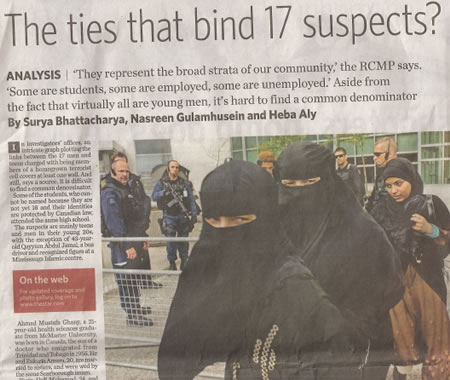
One picture sums up the reasons why people go online for the news
This is not a Photoshop. Seriously.
This is a real newspaper page.
Could anything sum up the failure of the western media
- and the reasons why people go online for the news -
better
than this page
from the Toronto Star
after the
2006 Canadian Islamic terror arrests?
What could these people have in common?
How could they have become somehow "radicalized"?
Who knows. Maybe they're a hiking group?
Agnostic stamp collectors?
Buddhist fanatics?
Anti-Canadian Jews?
Anglican school teachers?
Extremist librarians?
Whatever it is,
this newspaper doesn't want to say it for some reason.
If you want the news, you've got to go online.
The Elephant in the Room
by Andrew C. McCarthy:
"Over the weekend, Canadian authorities apparently smashed a frightening plot
involving Islamic terrorists who planned a series of bombings against sites in southern Ontario.
Instinctively, the mainstream media went into its now-familiar coverage template,
Phase One of which avoids like the plague any mention of the fact
that accused terrorists are Muslims."
When crimes occur, the media should tell us if the culprit is black, white or other.
Where are they from?
How old are they?
When terrorism occurs, the media should tell us immediately if it is Muslim or other.
Just tell us.
Tell us everything, without trying to spin it.
And trust us like adults to make our own conclusions.
Why is this such an old-fashioned idea?
See
hilarious followup
where the Toronto Star complains about being made an international laughing stock.
"Some readers accused the Star of "political correctness gone crazy"
and suggested the obvious link was religion."
Oh, "religion" is it now? You mean Christianity? Buddhism?
Idiots.
Blind, wilful idiots.
Classic sketch by
The 1/2 Hour News Hour
in 2007
on the media scratching its head about what links various terrorists.
More generally, the western media suffers from some basic problems
that distort the news:
Respect for third-world tyrants:
For some reason, presumably
because they are racists,
modern journalists are obsequious and respectful to
third-world tyrants and killers,
and never ask them hard questions.
They only ask tough questions to harmless democrats.
Diane Sawyer laughs with unelected Syrian fascist dictator Assad:
and asks him what's on his iPod, Feb 2007.
Rusty Shackleford
on people who are impressed that tyrants will give you a nice cup of tea and be charming:
"It's the same tripe that we get from the ignorant who think that the way people act in their personal lives somehow informs us of the political and social systems which they support. Individual behavior is not linked to political systems.
The most evil people in the world act in normal ways 99% of the time. They eat, drink, have families, love people, are nice to friends and neighbors, etc.
It's the 1% of the time you have to worry about. When they're busy beating their wives, sodomizing young boys, or stoning adulteresses.
If anyone still finds it surprising that evil people act normally most of the time: Get. A. Fucking. Clue."
Thatcher ran a free democracy and helped liberate dozens of countries.
Chavez ran an authoritarian state and achieved nothing.
Who gets the more positive obituary from the AP writers?
The foreign authoritarian.
J.P. Freire on the AP world view:
"You can challenge the status quo if you're a socialist, and then you'll get treated as a hero by the Associated Press, even if your oil-rich country is still an economic basketcase and a morass for the rule of law. But if you're a free market evangelist who succeeded in rescuing a nation from the hazards of an overweening state through privatizing, you're controversial. Gotcha."
Respect for third-world beliefs:
Similarly,
because they are racists,
modern journalists tolerate hatred and bigotry from the
third world that they would never tolerate from
first world people.
Morally neutral reporting is dishonest reporting
- Dennis Prager describes what is wrong with so many journalistic
conventions.
Why can the papers not say "Islamic mobs slaughter hundreds
in Nigeria".
Wouldn't that be more true than the pious whitewashes
about "ethnic tensions" and "cycles of violence"?
Mealy mouth media,
by Thomas Sowell,
on journalistic conventions.
- "One of the pious phrases of the mealy mouth media is that
"the truth lies
somewhere in between"."
General lack of scepticism about non-western sources:
The media has an admirable level of scepticism about, say,
IDF statements, or the Bush administration.
If only it would maintain that level of scepticism about, say,
its own Arab stringers,
or, say, the Lebanese government,
or, say,
what Arab villagers say to its reporters on the ground after an Israeli airstrike.
Good journalists should distrust and double-check everybody.
Reutergate
- Issues about the western media using images from local Arab stringers.
Reuters' Image Problem:
L.A. blog unmasks Hezbollah propaganda
by Brendan Bernhard.
"Johnson has raised the lid on a potential Pandora's box.
Namely, how our leading news agencies and newspapers increasingly rely on stringers
from hostile nations to tell us how we, or our allies, behave in wartime.
Since you'd be hard-pressed to find Muslims in the U.S., let alone Europe,
who aren't strongly anti-Israel and opposed to any American presence in the Middle East whatsoever,
why on earth would you expect to find neutral Arab reporters in Baghdad or Beirut?
This is the kind of question newspaper editors should be asking themselves (and their stringers)."
Refusal to ever praise the west:
For the media, a story does not exist unless it can cast some
sceptical look over western policy.
The idea of them saying:
"Government and military doing well,
given that they are humans. Not much to criticise."
seems absurd.
A story must criticise the authorities.
It must be negative, and slyly sceptical.
It must compare the government and military to
an imaginary utopia
where everything runs perfectly
(actually this is very much
the left-wing mindset).
This is all good and healthy, and essential to democracy.
But the point is, it can distort the news.
Governments do achieve good things.
Over the past 200 years, we have got richer.
We have got freer.
Tyrants have been destroyed and threats have
been ended forever.
But the media can never celebrate these things.
It must find things to be negative about.
And it will highlight these, even if they are trivial,
while ignoring the real story of success.
As I say, this is good and healthy.
Non-stop criticism is what makes democracy strong,
just as it does science.
My point is just that it distorts the news.
When government has a massive success, the media simply do not cover it.
Within days all their focus is on trivial problems
that people can feel bad about.
The Iraq War was the most amazing example.
The minute Iraq fell,
in perhaps the most amazing and powerful western military victory
since World War Two,
the minute it happened,
the media changed the subject.
The Dissenters Club
by Jean Bethke Elshtain,
on how intellectuals and the media
cannot support the government.
They must complain.
- "Somewhere along the line, the idea took hold that,
to be an intellectual, you have to be against it, whatever it is. The
intellectual is a negator.
Affirmation is not in his or her vocabulary.
...
The
widely repeated notion that no space exists within American society to make contrarian arguments is risible. Less
frequently heard, in fact, is intellectual assent
from academic and intellectual circles to something the government is
doing or that America is undertaking."
"Don't run, we are your friends"
in the movie
Mars Attacks!
Western journalists often find it hard to believe that enemies of the West are simply lying.
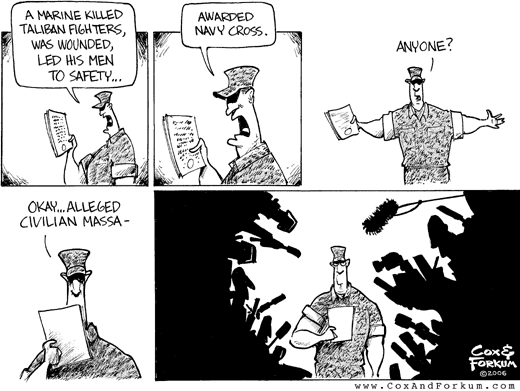
Western journalists are far more interested in western scandal than they are in western heroism.
Cartoon from Cox and Forkum
(see here).
See Cartoon Use Policy.
"Avoid using word combinations such as "Islamic terrorist" or "Muslim extremist" that are misleading".
"Avoid using terms such as "jihad" ...
The basic meaning of "jihad" is to exert oneself for the good of Islam and to better oneself."
"When writing about terrorism, remember to include white supremacist,
radical anti-abortionists and other groups with a history of such activity."
This is not a parody. They are serious.
Read these "guidelines"
and you will understand why the media has been so hopeless
during the entire War on Islamist Terror.
Every guideline is designed to confuse the reader about jihad and sharia,
and damage the struggle against those evil ideas.
These "guidelines" sum up what is wrong with the western media:
They follow these kind of guidelines instead of just reporting the news.
Only 6 percent of the national press corps describe themselves as "conservative".
In contrast, 36 percent of the overall population consider themselves conservative.
TV's Bad News Brigade,
Media Research Center, Oct 2005
- Survey of the American media's negative, defeatist coverage of the War in Iraq.
Of the 1388 stories sampled:
848 stories focused on negative topics or presented a pessimistic analysis of the situation.
Only 211 stories featured U.S. or Iraqi achievements or offered an optimistic assessment.
Even coverage of the Iraqi political process was negative.
124 negative stories focusing on infighting, etc.
Only 92 positive stories about the fact that the Iraqis have a political process at all,
for the first time in their history.
Just 8 stories recounting heroism or valor by U.S. troops.
79 stories on allegations of combat mistakes or misconduct by U.S. military personnel.
8 stories out of 1388 recounting allied heroism!
It's a wonder anyone ever joins the army,
when the culture is so indifferent to their sacrifice.
Of the full 2,400 statements referring to the United States,
49 percent were neutral, 34 percent were negative about the US,
and 15 percent were positive.
Of statements about terrorism,
58 percent were neutral, 38 percent were negative about the US,
and 3 percent were positive.
That is, of statements that took a line,
92 percent were negative about the US.
Of statements about Afghanistan,
48 percent were neutral, 44 percent were negative about the US,
and 7 percent were positive.
That is, of statements that took a line,
86 percent were negative about the US.
Of statements about Iraq,
59 percent were neutral, 33 percent were negative about the US,
and 7 percent were positive.
That is, of statements that took a line,
82 percent were negative about the US.
Of statements about the US and Israel,
43 percent were neutral, 35 percent were negative about the US,
and 13 percent were positive.
Of statements about US foreign policy in general,
25 percent were neutral, 61 percent were negative about the US,
and 14 percent were positive.
I would love to see such a study done of British
state-run BBC TV
or Irish state-run RTE TV.
I'm sure the numbers would be just the same.
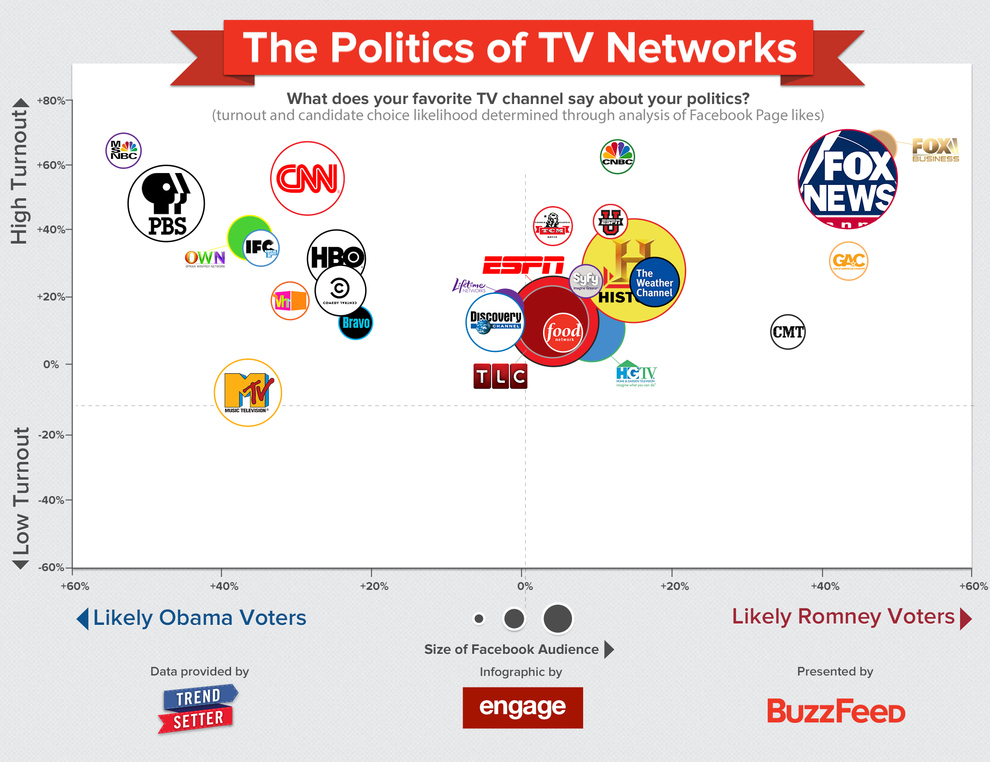
A fascinating study, 1 Nov 2012, correlating "likes" on Facebook.
Confirms that MSNBC, PBS and CNN are not centrist but rather are far left partisan.
From here.
Poll of Americans and which media they trust, Oct 2014.
Finds that the right trusts the mainstream media far less than the left.
The above survey tries to place the media on a left-right axis.
Fascinating.
Note that the BBC and The Economist and NPR are well left of centre.
In this paper, war heroes are MIA
by Frank Schaeffer:
"When it comes to reporting on the military, it's as if we're back in the 1950s,
only this time the media prejudice and insensitivity are aimed at military service rather than race.
In the 1950s, you rarely saw a story about an African American
unless he or she committed a crime
or was portrayed with condescension as a victim.""What I would like to see is acts of military heroism regarded once again as newsworthy."
20 members of the U.S. military have received the highest recognition for bravery
since the war on terror began.
14 of the country's top 20 medal recipients have gone unmentioned
by ABC, CBS and NBC.
Hero's tale is 'too positive' for the BBC, Apr 2007
-
BBC cancels profile of
Johnson Beharry, Victoria Cross winner
because it is "too positive" about the war.
The BBC
"feared it would alienate members of the audience opposed to the war".
Just like it often cancels programs that are negative about the war
because it fears they will alienate supporters of the war.
Yes, I've noticed that.
In the fighting in Fallujah:
"Hundreds of gripping stories of valor emerged that would have been publicized in World War II.
...
Not to take anything away from The Greatest Generation, but the behavior of our soldiers today will stand scrutiny when compared to the performance of those in any past war.
The focus of the press on abuse is not due to any relaxation in military discipline or social mores.
Why was valor considered front-page news in 1945 and abuse considered front-page news in 2005?"
"As a nation, we'd best be careful about what we choose to accentuate about ourselves.
This is not a plea for cheerleading; it is an argument for balance.
To subdue hostile cities such as Fallujah, our country needs stout infantrymen
such as the Marines and the paratroopers. Fed a steady diet of stories about bad conduct
and deprived of models of valor, the youth of America will eventually decline to serve."
(As is now true in Europe, for example.)
Coverage of top 20 U.S. military medal recipients on U.S. network television,
in the five years from 2001-2006.
From the study:
Touting Military Misdeeds,
Hiding Heroes.
Trailer for the documentary
The Tillman Story (2010).
Pat Tillman
was killed by friendly fire
(during actual combat with the enemy)
in Afghanistan in 2004.
But he is still a hero.
Friendly fire happens in all war.
But because it was initially said that he died from enemy fire,
there is of course a major leftie film
sneering at the story and the idea that he was some sort of "hero".
Correct me if I'm wrong,
but have I missed dozens of films about American
heroes in Afghanistan?
Why is this story so exciting to leftists?
A good comment says:
"Do those assholes ever stop to think that maybe it's them? Maybe they're the ones dragging Pat Tillman's service through the mud with this political crap. No, of course not".
Another comment:
"These lefties couldn't give a rats ass about Pat Tillman. They thought he was a stoooopid jock when he was playing football and then plain stooopid for joining the Army instead of making millions ... Now they're going to use his corpse to take another hit at Bush."
The complex, tragic life and death of Pat Tillman, by Kyle Smith, August 15, 2010, notes that Tillman was a complex figure.
He supported the Afghan war
but opposed the Iraq invasion, for example.
But my point is not that Tillman was a neo-con hero.
My point is: Why this story?
Why don't movie makers make films about the hundreds of uncomplicated American heroes
killed in action against the enemy?
Why is this kind of story so interesting to them instead?
The media's obsession with bad news
distorts the news.
It distorts our picture of what is going on in the world,
instead of enlightening us.
This was nowhere more obvious than in the media's
distorted coverage of Iraq in 2003.
Having been
wrong about the war
from start to finish,
the media were utterly unashamed and unrepentant.
Barely pausing for one day to mark
the liberation of millions of people,
they got straight back to their old ways.
The same ignorant voices
that were wrong about the war
were back again, whining about the post-war "quagmire".
Within days of liberation,
the media were (and would remain) incessantly focused on bad news
in Iraq:
Winning After All by Victor Davis Hanson
- Do not expect to read headlines like
"85% of Baghdad's Power Restored,"
"Afghan Women Enroll in Schools by
the Millions," or "Americans Put an End to Secret Police
and Arbitrary Executions in Iraq."
The Iraq we don't hear about
by Amir Taheri, June 06, 2004,
on how the media don't want to tell the truth about Iraq.
- "During the past 10 months elections have been held in 37 municipalities.
In each case victory went to the moderate, liberal and secular candidates.
The former Ba'athists, appearing under fresh labels, failed to win a single seat.
Hardline Islamist groups collected 1% to 3% of the vote."
Not So Innocent
by Ralph Peters
- The western media as a combatant.
Even worse, a pro-Saddam combatant.
The media have ".. resorted to a death-by-one-thousand-cuts strategy.
.... They failed to stop the war and they failed to lose the war.
But they haven't stopped trying to reverse the result, and it bids fair that they will yet do so."
"So here's the question of the week, month, year: After Iraq, will the media ever again allow a democracy to topple a fascist dictatorship?"
You can read the US soldiers' blogs direct on the Web,
instead of filtered through the bias of the media:
The election was a day of joy,
one of the greatest days in Iraq's history,
but:
"You would never guess that from some British media reports,
which are about as cheerful as coverage of a funeral. There is no difficulty telling the difference
between the BBC's Caroline Hawley and a ray of sunshine. You get the impression that most commentators
are disappointed that the elections happened at all and, when they did, were secretly hoping for an outrage
so dreadful it would turn 30 January into a day of wailing rather than cheering.
There was a brief flicker of hope for the press pack when a British Hercules aircraft crashed,
killing nine RAF personnel and one soldier.
...
The crash gave commentators what they wanted: an excuse to downplay the success of the first democratic elections
in which many Iraqis had ever taken part, and imply that they were a failure."
Alternatives for Germany,
Allen W. Dulles,
Foreign Affairs, April 1947.
- "The defeat of Nazism has removed one of the obstacles to the democratization of
Germany; but it has not created a democratic Germany. Nor is there much basis for
the belief that democracy will develop in Germany under present conditions of
defeat, hunger, idleness and despair."
History's Verdict:
The summers of 1944 and 2004
by Victor Davis Hanson
- We think of the D-Day invasion as a "success",
but the Allied losses, mistakes and crimes
dwarf anything seen in the Iraq campaign.
History airbrushes the D-Day campaign with success,
but the modern media would have been screaming for
blood and the resignation of all the Allied leaders.
Parodies
- How our modern media would have reported WW2:
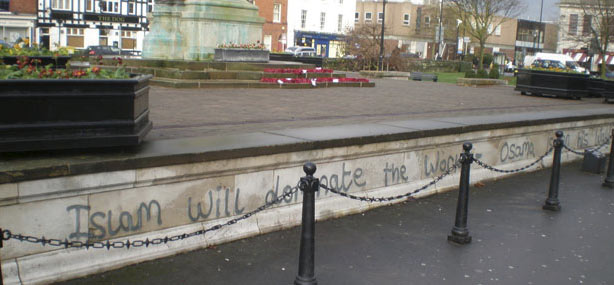
The Burton Mail, 19 Dec 2009,
writes about it as if the far right had done it.
They refuse to print what the graffiti said.
They refuse to print a photo of it.
They just say it is "an extremist message".
They treat their readers as children.
They quote someone saying "there are other ways of expressing your anger about certain issues".
The paper never explains what "certain issues" are.
I'm none the wiser at the end of the article.
The paper quotes the chairman of East Staffordshire "Racial Equality" Council,
who says the whites are to blame:
"he suspected someone from the far right was responsible".
He even says the graffiti included "racist material"
when it clearly doesn't.
As so often, you need to go on the Internet for the full story,
and to actually see the graffiti.
Again, the graffiti is not the real story.
The real story is the media.
Months later, we find out the truth.
Oddly, the East Staffordshire "Racial Equality" Council were wrong:
The graffiti said:
"ISLAM WILL DOMINATE THE WORLD - OSAMA IS ON HIS WAY - KILL GORDON BROWN"
His facebook page
links to Islamic extremists and jihadis.
An identical slogan is daubed by some savage in Dec 2011 on the ancient
Sandal Castle, Wakefield, West Yorkshire. "KILL ALL KUFFARS -
ISLAM WILL DOMINATE THE WORLD"
said the savage.
At least the
Wakefield Express,
unlike the Burton Mail,
has the guts
to print the story.
The New York Times
then refused to
run this ad from
Pamela Geller.
Their mickey mouse excuse was that running the ad
"could put U.S. troops and/or civilians in the [Afghan] region in danger."
Yeah, whatever.
This is why we love the Internet.
We don't have to obey you any more.
The exact same thing happened with the Washington Post:
The Washington Post ran the above anti-Catholic ad on May 8, 2012.
Again, no problems with that. That's free speech.
The problem is what happened next.
Pamela Geller
submitted the above ad directed at Islam
and - of course - the Washington Post refused to run it.
Classic spin from the New York Times:
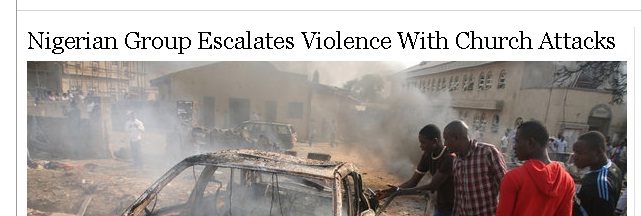
"Nigerian Group Escalates Violence With Church Attacks", New York Times, December 25, 2011, on the Boko Haram slaughter.
The spin starts with not including "Islamic" or "Islamist"
in the title.
It then goes on to claim that
killing for Islam is somehow new for this group:
"Boko Haram until now mostly targeted the police, government and military in its insurgency effort, but the bombings on Sunday represented a new, religion-tinged front".
Two minutes Googling would have taught them that Boko Haram
are about
nothing but religion,
and have been slaughtering for religion since the start.
Why does the New York Times feel the need to hide this?
The result of journalists wanting to "change the world"
rather than "report the news".
Before they looked like the top, questioning everyone and everything.
Now they lecture the little people, on behalf of the powerful, who agree with them.
Posted here.
 and asks him what's on his iPod, Feb 2007.
 Media Research Center, Oct 2005
- Survey of the American media's negative, defeatist coverage of the War in Iraq.
Of the 1388 stories sampled:
Media Research Center, Oct 2005
- Survey of the American media's negative, defeatist coverage of the War in Iraq.
Of the 1388 stories sampled: