As I explain
here
and
here,
I am a libertarian or a classic (18th century) liberal.
I agree with liberals on things like domestic civil liberties,
free speech, free private life,
freedom of sexuality
and freedom of religion
(and freedom from religion).
But I agree with conservatives on things like the economy,
crime
and foreign policy.
Liberals lead to freedom at home,
but are disastrous abroad.
Only
conservatives
understand how the world as a whole works
- that the world is full of folly and brutality,
that the west is imperfect but the best there is,
that it must now and always be defended against its enemies.
Reagan speech
on the 40th anniversary of D-Day, 1984. "Forty summers have passed since the battle that you fought here. You were young the day you took these cliffs; some of you were hardly more than boys, with the deepest joys of life before you. Yet you risked everything here. Why? Why did you do it? What impelled you to put aside the instinct for self-preservation and risk your lives to take these cliffs? ...
You all knew that some things are worth dying for. One's country is worth dying for, and democracy is worth dying for, because it's the most deeply honorable form of government ever devised by man."
The right has the best record on freedom
Having destroyed
the Nazis, Mussolini, Imperial Japan, the Soviets,
Milosevic, the Taliban and Saddam,
America and its "right-wing" supporters are,
it seems to me,
the greatest defenders of freedom in practice
in this world.
I do not deny that
the defence of the west has involved crimes,
the worst of these by far being the bombing of civilians in WW2,
and the collaboration with Russia in WW2.
But
the fundamental points remain,
that the left will not support,
that:
(a) the west is the best part of planet earth
- everywhere else is worse,
and:
(b) the west does
need to be strongly defended.
The abandoning of South Vietnam
to the communist butchers
after 1973.
South Vietnam fell in 1975.
The abandoning of Cambodia
to the communist butchers
after 1973.
Cambodia fell in 1975.
Support for
right-wing tyrannies like
Pinochet
and
El Salvador
in the Cold War.
The US made up for this everywhere by
making the right-wing tyrannies it once supported
move to democracy,
once the communist threat was defeated.
South and Central America
are the most notable successes
of this policy.
Support for
the Islamists
fighting the Soviets in Afghanistan.
The US made up for this by
bringing down the Islamist regime in 2001.
America's treachery in the
Suez Crisis of 1956
in standing with the tyranny of
Egypt
against the democracies of Britain, France and Israel.
In the War against Islamism
Support for
Saddam's Iraq
against Islamic fundamentalist Iran.
The US made up for this by bringing down Saddam's regime in 2003.
Support
for unfree Islamic states like
Saudi Arabia, Kuwait, Qatar, Egypt
and Pakistan today.
Support for other unfree states
that have been useful in the war,
such as
Uzbekistan, Kyrgyzstan and Tajikistan.
Support and funding for
the Palestinian Authority
"police" and "security forces".
My idea of an ethical foreign policy
is to
only ever be allies with free countries.
But I have sympathy for the politicians, who are often
faced with horrible choices.
I accept that to defend the west without any alliances
with unfree regimes
seems impossible.
Unfree regimes (notably Pakistan
and Kuwait)
were essential to the wars on
Afghanistan and Iraq.
Should their help have been rejected?
I accept that it is easier to be an idealist than a politician.
The World's Champion Villain, by Randall Hoven, February 20, 2007.
List of 20th century democides
points out the obvious
- that America is largely irrelevant to the story
of 20th century democide.
Don't Judge a Nation by Its Friends
(judge it by its enemies), 23 May 2003.
Considers the problem of alliances with unfree
regimes for the sake of a greater goal.
Points out that the alliance with Russia in WW2
was by far the worst of these.
The Continuation War, 1941-44
shows where realpolitik leads.
The democracies of the US and UK support the vile tyranny of the Soviet Union
to help them defeat Nazi Germany.
The democracy of Finland supports the vile tyranny of Nazi Germany
to help it defeat the Soviet Union.
As a result, democratic states end up at war with each other.
Victor Davis Hanson, December 10, 2007,
lists some of the intelligence failures, strategic errors,
tactical errors
and realpolitik alliances
of American military history.
The Iraq War has been better than average so far.
He notes how humans once accepted error:
"Yet until the defeat in Vietnam, there was a sort of tragic acceptance of military error as inherent in war. Ours was once a largely rural population, inured to natural disaster and resigned to human shortcoming. ... the common desire for victory usually overcame perpetual finger-pointing and serial despair.
...
Again, what loses wars are not the inevitable mistakes, but the failure to correct them in time and the defeatism and depression (because errors occurred at all) that we allow to paralyze us."
He also points out how we rarely dwell on our enemies' mistakes:
"the enemy, being less introspective and self-critical, was even more prone to military error than we - and less likely to innovate and correct.
...
There is no need to document the stupendous strategic and tactical blunders that led to Saddam's ignominious defeat. But in his wake (and after his demise), the supposedly sophisticated jihadists have made just as many mistakes. In a self-proclaimed war of Islamic liberation, al-Qaeda in Iraq has mutilated, butchered, and terrorized a once largely sympathetic population. As a result they have nearly pulled off the impossible: a formerly receptive Sunni tribal community has turned against Sunni Muslim jihadists, and joined with American infidels, sometimes alongside the troops of a Shiite-led government."
As always, Hanson provides hope.
He says we cannot see the wood for the trees:
"The Iraq war and the larger struggle against the anti-American jihadists can still be won - and won with a resulting positive assessment of our overall efforts by future historians who will be far less harsh on us than we are now on ourselves."
Power
by Bill Whittle
- on how America is not perfect.
Just better than the alternatives
in this imperfect human world.
For example, European
or UN
leadership
would clearly lead to a worse world than American leadership.
I never claim America is perfect.
Just that it is the best.
Disgrace:
US aid helps Lebanon arrest Israeli intelligence cell, May 2009.
The Israelis were gathering intel on Hezbollah.
Hezbollah hate America and have slaughtered hundreds of Americans.
And yet American aid helped Hezbollah against Israel.
The brave Israeli agents face torture and death.
This disgrace - this treason against the West - happened on Obama's watch.
Comment:
"There aren't a lot of things that make me feel ashamed to be an American, even for a second, but this sort of betrayal of America's friends is very high on that very short list."
French foreign policy
I don't include in the list above
the long list of tyrannies that France has supported -
from Hutu Rwanda
to Saddam's Iraq
to genocidal Sudan
to communist China
to the thug Mugabe
- since I do not regard France as in any way a "leader" of the west.
I am defending the American-led west.
I do not offer any defence of French foreign policy,
since it is not defensible.
In fact, I am generally opposed to French power.
France is a perfectly nice place domestically,
but its foreign policy
is irresponsible and amoral,
and I am hostile to any increase in French power in the world.
I would like to see France lose its UN Security Council seat, for example.
Worse than Pinochet, El Salvador, Saddam, the Afghan Mujahideen,
Suharto, Marcos,
Saudi Arabia or Pakistan.
This is the worst example of realpolitik in the history of the West
- the alliance with the Soviets in WW2.
US government poster, 1942.
Public domain image from
here.
"The Cairo and Teheran Conferences ... gave me my first opportunity to meet the Generalissimo, Chiang Kai-shek, and Marshal Stalin - and to sit down at the table with these unconquerable men
... I met in the Generalissimo a man of great vision, great courage, and a remarkably keen understanding of the
problems of today ... Today we and the Republic of China are closer together than ever before in deep friendship and in unity of purpose.
....
After the Cairo Conference, Mr. Churchill and I went by airplane to Teheran. There we met with Marshal Stalin.
...
I may say that I "got along fine" with Marshal Stalin. He is a man who combines a tremendous, relentless determination with a stalwart good humor. I believe he is truly representative of the heart and soul of Russia; and I believe that we are going to get along very well with him and the Russian people
....
Britain, Russia, China, and the United States and their allies represent more than three-quarters of the total population of the earth. ... those four powers must be united with and cooperate with all the freedom-loving peoples of Europe, and Asia, and Africa, and the Americas.
The rights of every Nation, large or small, must be respected and guarded as jealously as are the rights of every individual within our own Republic.
The doctrine that the strong shall dominate the weak is the doctrine of our enemies - and we reject it."
-
FDR's disgusting "Fireside Chat", 24 December 1943.
He talks as if the democidal tyrants
Chiang Kai-shek of China
and Stalin of Russia
share the same vision of the world as the democracies do.
Does he really believe this?
He talks as if he does.
American foreign policy is still
today often in conflict
with American values of democracy and freedom.
Not its support of the democracy of
Israel,
which is perfectly right and proper.
Rather its support
of unfree states like
Saudi Arabia, Egypt
and Pakistan,
that share no common values with the west,
and where human rights do not exist.
These regimes should be dumped by the US.
It is long overdue.
The Real Roots of Arab Anti-Americanism
by Barry Rubin
- discusses America's long history of support for
the Arab Islamic world,
which has yielded it nothing but hatred.
America needs to change its policy,
and become a much more aggressive force for
democracy and change in the Middle East.
The new policy - the policy of actively
trying to change the Middle East,
and end tyranny and spread democracy
- is the last resort, the only one that hasn't been tried,
the only one that will actually work:
".. too often we discuss the present risky policy without thought of what preceded it
or what might have substituted for it. Have we forgotten that the messy business of democracy
was the successor, not the precursor, to a litany of other failed prescriptions?
...
After the failures of all our present critics, this new policy of promoting American values
is our last, best hope. And the president will be rewarded long after he leaves office
by the verdict of history for nobly sticking to it when few others, friend or foe, would."
In the end, bruised by Iraq, Bush did nothing about America's sordid alliance with
Egypt, Pakistan, and Saudi Arabia.
Neither did Obama.
Barack Obama: Dump These 8 Unsavory Allies by Kenneth Roth of HRW, 2 Jan 2013.
Skipping over HRW's boilerplate about Israel,
it is a good article.
Roth says America should dump
Afghanistan, Uzbekistan, Cambodia, Rwanda, Ethiopia, Saudi Arabia, Bahrain and Mexico.
Pretty good, but how about Iraq, Pakistan, Egypt, UAE and the PA?
Ralph Peters
shows how to criticise policy
while still being pro-West:
Peters is as gung-ho and idealistic
a supporter of Bush's war as you will get,
and what he criticises America for is what I criticise it for
- its appalling "realpolitik" history of support for
Arab tyrants.
Our True Enemies
- "Until the recent war against Saddam's regime, we never stood up for freedom in the Arab world."
Bush's speech of 2003
indicates that he gets it
(or at least, that the debate is raging
in his administration).
Michael Ledeen
also does a good line in scepticism and caution.
He is gung-ho in favour of the war on Islamism,
but worries that we are not serious enough.
Our Moment of Vainglory
worries that the diplomats are going to turn military victory
into defeat - by allowing the establishment of
"friendly tyrannies" in Iraq and Afghanistan.
If so, the war will only be postponed, not ended.
Cox and Forkum blog
also does a good line in scepticism,
and thinks the US has not got remotely serious enough
with Islamist and communist states.
They also refuse to be happy with
Iraq and Afghanistan until these countries
become free societies.
"Our SOB"
- Cox and Forkum fed up with the realpolitik
support for the tyrant of Uzbekistan,
just because he is useful in the War on Islamism.
Capitalism magazine
also shows how to criticise the Bush administration
while still remaining clearly onside
and pro-War-on-Islamism.
Indeed, they criticise the Bush administration
for caring too much what Europe and the UN think.
The main debate on the right, among the pro-West critics above,
is whether it is acceptable if regime change leads to simply a leader
chosen by the majority (the narrow definition of "democracy"),
or leads to an actual free society (the broader definition of "democracy").
"Democracy Is"
by Cox and Forkum
-
Democracy is not a majority vote.
It is the whole works - free speech, freedom of religion, repeated free elections.
It is not acceptable if Iraqis vote for an Islamic state:
"it would be far more than merely "disappointing" if Iraq becomes a fundamentalist Islamic state.
It would be a defeat for us in the war on terror."
Or, if you like, what I am in favour of
is not democracy.
It is a free society:
"A democracy, if you attach meaning to terms, is a system of unlimited majority rule
...
Democracy, in short, is a form of collectivism, which denies the individual rights:
the majority can do whatever it wants with no restrictions."
Despite the above issues,
America,
the oldest democracy in the world,
is the country in the world best suited to hold power,
and every lover of freedom
should support America at a time like this.
What's So Great About America
by Dinesh D'Souza
- "America is the greatest, freest, and most decent society in existence.
It is an oasis of goodness in a desert of cynicism and barbarism.
[It is] the
last, best hope for the world."
I agree - and I, like D'Souza, am not American.
My only criticism
is he does not seem to acknowledge that
the American life can be lived to some extent throughout
the west.
For example almost everything he praises exists in Ireland too.
People need to consider what it would be like if America did withdraw from leading the world.
The main criticism of the dream of socialism / communism is that
it is not enough to criticise the existing world
and propose alternatives.
It is necessary to prove
that the alternatives are better.
Similarly, it is not enough to complain about America being the only superpower.
It is necessary to prove
that the alternative world is better, not worse.
"Critics of U.S. global dominance should pause and consider the alternative. If the United States retreats
from its hegemonic role, who would supplant it? Not Europe, not China, not the Muslim world
- and certainly not the United Nations. Unfortunately, the alternative to a single superpower
is not a multilateral utopia, but the anarchic nightmare of a new Dark Age."
"Unfortunately, the world's experience with power vacuums
.. is hardly encouraging. Anyone who dislikes U.S. hegemony should bear in mind that,
rather than a multipolar world of competing great powers, a world with no hegemon at all
may be the real alternative to U.S. primacy.
Apolarity could turn out to mean an anarchic new Dark Age: an era of waning empires
and religious fanaticism; of endemic plunder and pillage in the world's forgotten regions;
of economic stagnation and civilization's retreat into a few fortified enclaves."
"If the United States retreats from global hegemony
- its fragile self-image dented by minor setbacks on the imperial frontier
- its critics at home and abroad must not pretend that they are ushering in a new era
of multipolar harmony, or even a return to the good old balance of power.
Be careful what you wish for."
Appeasement Then and Now,
FrontPage Symposium, Dec 2002,
on whether America should go out there
and try and change the world, or stay at home.
Pat Buchanan makes the case for staying at home.
Victor Davis Hanson says the world would become a terrifying place
if America did.
The World Without US
(2008 documentary).
What would happen if the US were to stop its interventions
around the world?
The video
"A World Without America".
By 18 Doughty Street, Feb 2007.
It is true that America has committed crimes,
but can you name any country in world history
that has done more good than America?
I cannot.
Why America is Great
by Daniel J. Flynn
-
"What country in the history of the world
boasts such an impressive record of bettering the lot of all of humanity?"Name that country,
if it's not America.
Victor Davis Hanson
- "Kurds and Shiites support us for obvious reasons
- no other government on the planet
would risk its sons and daughters to give them the right of one man/one vote."
If there is any other country on earth which will give the
Kurds freedom, then
name that country.
Pew Survey, July 2007.
When asked to name their home country's most reliable allies in the world:
The US was the no.1 choice in:
UK, Canada,
Israel, Japan, South Korea, South Africa, India, Kuwait,
Mexico, Peru, Brazil, Chile,
Ghana, Kenya, Ethiopia, Nigeria, Uganda, Mali, Tanzania.
The US was the no.2 choice in:
Germany, Italy, Czech Republic, Poland, Morocco, Ivory Coast, Senegal.
The US was the no.3 choice in:
France, Bangladesh, Malaysia.
And remember, not all countries were polled.
Survey of Americans, Sept 2009, asks them which countries are their allies and enemies:
86 percent of Americans say Canada is an ally.
85 percent of Americans say UK is an ally.
70 percent of Americans say Israel is an ally.
66 percent of Americans say Germany is an ally.
61 percent of Americans say France is an ally.
59 percent of Americans say Japan is an ally.
39 percent of Americans say Egypt is an ally.
23 percent of Americans say Saudi Arabia is an ally.
The Statue of Liberty,
for generations a beacon of hope
to the oppressed peoples of the world,
that here, at last, was a land where they could be free.
Photo by Bjorn Ruwald, 2004.
See terms of use.
From here.
The American public understands the world pretty well.
Would the Irish public be so sensible?
From Feb 2015 survey.
Note the high rank of Israel, and the low rank of the thuggish PA.
Note the low ranks of Iraq and Afghanistan, who have rejected American attempts to make them better places.
Note the low rank of America's "ally" Pakistan, which sheltered Bin Laden.
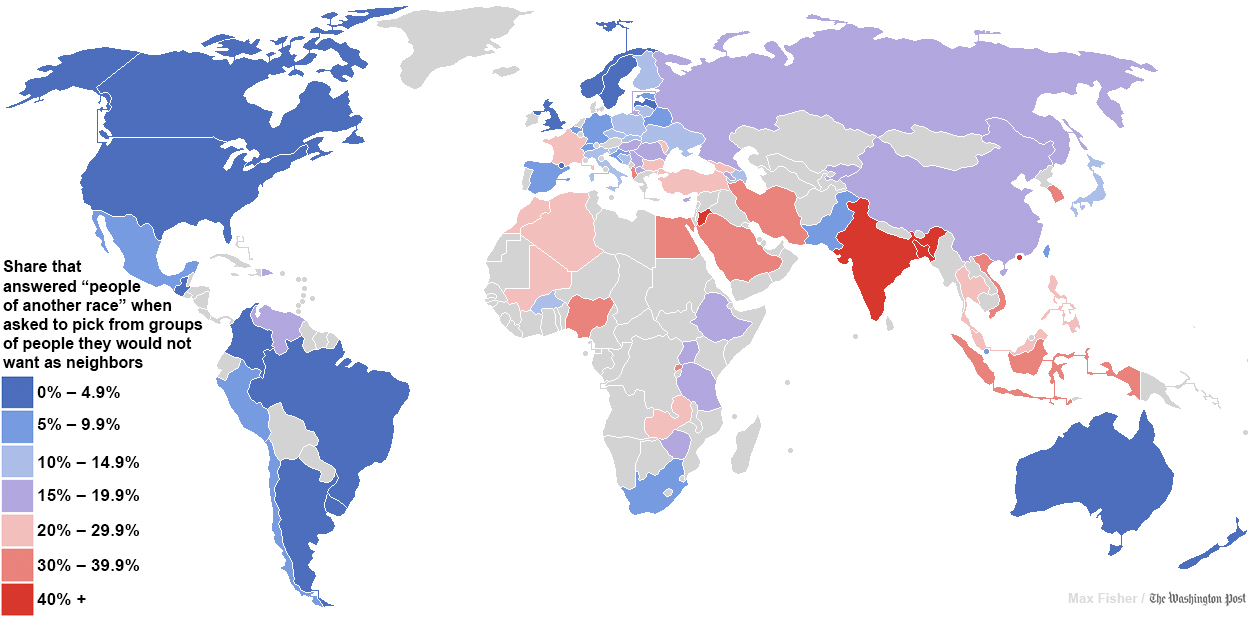
The
World Values Survey
surveys racist attitudes around the world.
And of course the West comes out looking pretty good.
The World Values Survey
site
is almost impossible to use.
Here is how I managed to compare Nigeria with US and UK:
Data - Documentation - Wave 6 - Nigeria 2012 - Codebook - Results.
Question
V37. "On this list are various groups of people. Could you please mention any that you would not like to have as
neighbors?"
People of a different race - 21 percent of Nigerians said they do not want that.
Wave 6 - USA 2011.
People of a different race - 6 percent of Americans said they do not want that.
Wave 5 - Great Britain 2005.
People of a different race - 5 percent of British said they do not want that.
Ireland was never surveyed.
The world's most racist (red)
and least racist (blue) countries.
(Grey not surveyed.)
See full size.
From
2013 article.
The numbers
are similar but a bit different to the ones I found in the database above.
The least racist places in the world (among those countries surveyed)
were:
United States, Canada,
Brazil, Argentina, Colombia, Guatemala,
Britain,
Sweden, Norway, Latvia,
Australia, New Zealand.
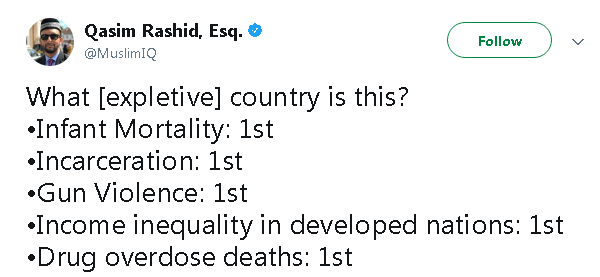
Leftie propaganda show
The Newsroom
makes a big speech about how America is not the greatest country in the world.
Of course, some of his facts are lies.
The US is
178th in infant mortality??
What a load of rubbish.
And
180 countries in the world have freedom??
Complete nonsense.
He knows nothing about the world.
But apart from that, allow me to suggest (as a non-American) a few things in reply.
Reasons why America is the greatest country in the world:
And again, just ask the leftie scriptwriters
what is
the greatest country in the world, if it is not America,
and watch them stumble.
They will either (most likely) refuse to answer,
or else you will get some mumbled hilarious answer like "Sweden".
Come on lefties, give us your answer!
Who is your number 1?
More on The Newsroom:
What Your Favorite TV Shows Say About Your Politics, 1 Nov 2012.
A study correlates "likes" on Facebook.
The Newsroom turns out to be about the most political show out there.
"Liking" it is more strongly correlated with the far left than any other show.
Irish leftists often mock Americans as "stupid".
So I like to point out
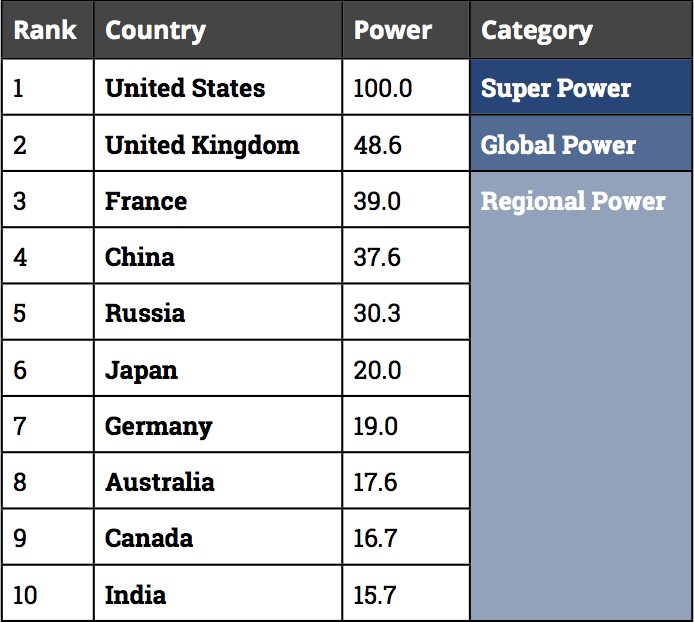
the following stats to them.
Kurlantzick notes there are many problems with the idea of the "Asian Century"
- innovation, science, technology, censorship, military power, demographics, lack of immigration,
political conflict.
But let me focus on one fundamental issue that the "Asian Century" people ignore:
The USA leads the world with the tacit consent
of much of the world.
Its ideas inspire freedom-lovers all over the world (like me).
Many of us prefer the USA even to the UN and EU, let alone alien powers like China.
Whereas
China would have to lead the world by force.
It has no ideas that are attractive to anyone outside China.
No one wants China to lead the world.
Not even Asian countries.
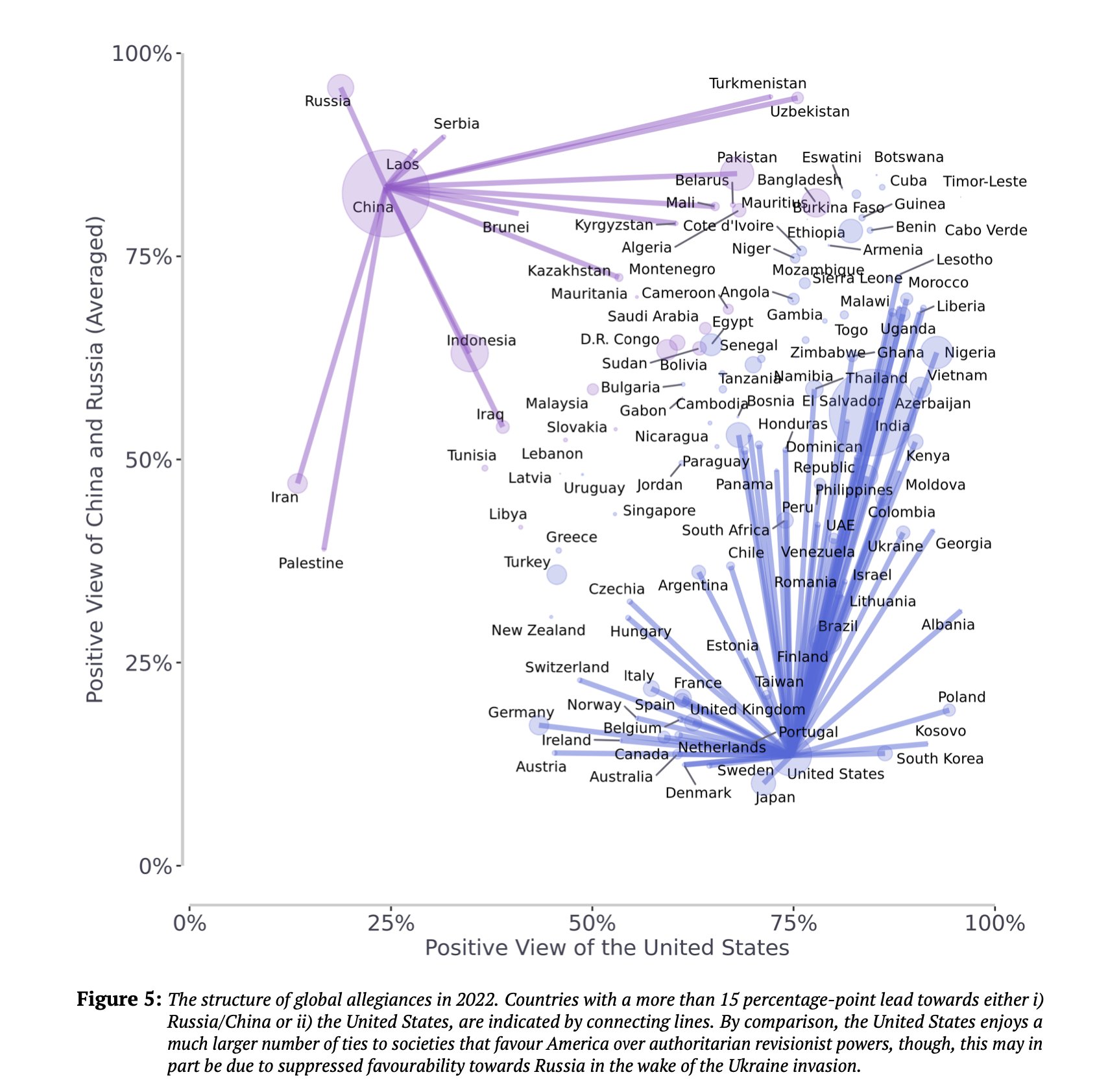
India and Japan don't.
"People in many Asian nations have extremely negative views of their neighbors - even though they maintain positive images of the United States."
Could a more unified Asian bloc lead the world, then, like the EU?
Not really. As the article quotes:
"The argument of an Asian century is fundamentally flawed in that Asia is a Western concept,
one that is not widely agreed upon [in Asia]".
Asia does not have ideas to export
to inspire the world the way the USA,
Britain
and (in a bad way) the Soviet Union had.
"the United States is a champion of an idea that has global appeal, and Asia is not."
And this matters,
because it means their growing economic strength (which is a good thing to see, in my opinion)
won't translate into diplomatic or cultural strength.
No free country should ever let China have military bases on its soil, for example.
No free country should ever let Chinese military use its waters or airspace.
No peace process should ever use China as a guarantor.
"No one in the world trusts anyone else to play the global hegemon, so it still falls to Washington."
What the "Asian Century" people miss is that America leads by consent.
Asia would never have that consent.
It would only have force.
And that lack of consent will give it less power, not more, in the world.
As Kurlantzick concludes:
"I have rarely met anyone, in any country, who wanted to move to China, or India, or even Japan, rather than the United States. Foreigners may want to spend a few years in China or India or Indonesia, to see the dynamism of these places, but few, if any, have plans to become Chinese, Indian, or Indonesian citizens. Perhaps one day China or Indonesia or India will draw these migrants, who would come seeking the same dreams and openness as they do today in the United States. But it won't be soon - and it might not even be this century."
Everyone wants America to lead the world:
The State Department cables leaked by
Wikileaks in Nov 2010
illustrate vividly that, whatever they say in public,
most leaders around the world want America to lead, and to take action against terrorism and rogue states.
Saudi Arabia, Kuwait, Bahrain, the UAE, Oman, Egypt and Jordan
all want America to stop Iran's nuclear weapons program.
Yemen wants America to bomb Al Qaeda in Yemen.
Dominique Moisi,
French political scientist:
"The one country in the world that is carrying a universal message remains America.
There are other powers in our multi-polar world: China is important, Russia cannot be neglected. But neither of these countries carries a universal message. Only America does. China wants to be big and is going to be big, but it has rather selfish aims.
What makes a difference is that no one in the world dreams of becoming Chinese or becoming Russian. But millions of people in the world, even some Europeans, still dream of becoming American."
Today, in the Islamist War,
all 10 of these countries are either supportive of the allies
or are neutral.
Truly, these are good candidates for the best 10 countries in the world.
Our uprising brought down FF with Pencil Revolution, Lise Hand, 28 Feb 2011,
celebrates the fact that in the Republic of Ireland, angry citizens waited until the
election
to express their fury with the FF/Green government.
The citizens did not turn to rioting and violence.
The citizens have an incredibly strong commitment to parliamentary democracy.
They waited for 3 long years
and then destroyed FF and the Greens coldly, at the ballot box -
where all changes of government in Ireland have occurred unbroken since 1923.
"To Kill An American".
America is not a place. It is an idea.
This is why non-Americans like me can get so excited about it.
Whereas so many countries represent some ethnic or tribal identity, which leaves non-members utterly cold.
Where this excellent short video perhaps goes wrong is in failing to understand
that those who want to kill Americans
(such as fascists, communists and Islamists)
know precisely that America is an idea,
and they hate that idea.
Islamists, for example, absolutely hate the idea of freedom of religion.
Ignore the crap written by the guy who posted this to YouTube.
Ah, I see the source of the naivety.
"To Kill An American" is by
the naive and innocent
Matthew Modine.
"And in some small corner of this vast
country, out in Nevada or Idaho or these places I've
never been to but always wanted to go
- I know out there, there's a guy getting on with his
life, perfectly happily, minding his own business,
saying to you, the political leaders of this country,
"Why me, and why us, and why America?"
And the
only answer is because destiny put you in this place
in history in this moment in time, and the task is
yours to do. And our job - my nation, that watched
you grow, that you fought alongside and now fights
alongside you, that takes enormous pride in our
alliance and great affection in our common bond -
our job is to be there
with you."
-
Tony Blair's address to Congress
after the toppling of Saddam, July 2003,
on why America has the thankless task
of saving the world
(and why everybody else in the West should support them).
"I believe in American exceptionalism, just as I suspect that the Brits believe in British exceptionalism and the Greeks believe in Greek exceptionalism."
- The unimpressive President Obama,
Apr 2009,
when asked whether he believes in American exceptionalism.
Well I am not American, and let me reply.
I am Irish, and I do not believe in Irish exceptionalism.
Ireland has proven again and again (WW2, Cold War, Israel)
that while it is a perfectly nice democracy,
it has no political leadership (or even moral leadership) role to play in the West.
I do believe in American exceptionalism, even if Obama doesn't.
America has proven again and again that it is the primary defender of the West
and of human freedom.
We all look to America for leadership, and we hope that President Obama is not as bad
as his awful rhetoric makes him out to be.
In memory of Ronald Reagan, 1911-2004.
The man who won the Cold War for the free world.
The man who destroyed communism.
The man to whom we owe our freedom.


 When asked to name their home country's most reliable allies in the world: