Islamism - The solution - The Islamic world must change
The modern, globalised, utopian movement of
Islamism
poses a threat to all free countries.
How big that threat is remains to be seen.
But the solution is clear.
The solution is not to
appease this evil philosophy.
The solution is that America and the
West must
assert their values,
and find ways to spread them
and destroy Islamist culture.
The solution is
the Islamic world must change.
Ultimately, by a long cold war and various hot wars,
the ideology
of Islamism must be destroyed.
Islamism - or any ideology that denies human freedom -
should have no place in our world.
To prevent more 9/11s or even a nuclear attack on the West, Islamism must be destroyed
in the early part of this century.
Terror-sponsoring regimes must be ended.
The poison being spread by clerics and media must be stopped.
The West must stop supporting Islamists both at home and abroad.
Needless to say, this work has not even begun.
-
The Bush Doctrine in Light of Madrid,
Thomas Patrick Carroll, March 25, 2004,
on how defence is not enough.
"The carnage in Madrid is a glimpse of the future for any nation in which counterterrorism passes for a national strategy against destructive ideologies like militant Islam.
The great virtue of the Bush doctrine is its aggressive, even belligerent, stance against al-Qaida and the states that enable it.
The best we can hope for from the defensive model are reasonably long breathers
- months, maybe even several years - between vicious and evermore deadly attacks. Only a strategy that promotes genuine change in the Middle East, as the Bush doctrine does, holds out the possibility of victory and an end to terror."
-
Israel's Fence and the Return to the Barbaric Past,
John Lewis, 27 May 2003,
on the continued existence of
barbarism in the world.
He rejects the idea that the solution is for the free countries
to defend themselves against the barbarians indefinitely.
"every nation in the world .. has
accepted primitive warlords as a fact of modern life.
But this cannot last.
Every ancient walled fortress eventually fell, since a good defense
could at best hold off invaders for
a while."
The only long-term solution is to go on the offensive and
defeat the enemy, destroy his plans, crush his dreams.
The dream of changing the Middle East
-
I believe in democracy, human rights, free speech
and freedom of religion
for all mankind,
including the Arab world.
That is why I am a neo-conservative.
- Christopher Hitchens,
7 Nov 2002, on the case for regime change in Iraq:
"After Sept. 11, several conservative policy-makers
decided in effect that there were "root causes"
behind the murder-attacks. These "root causes" lay
in the political slum that the United States
has been running in the region, and in the rotten nexus
of client-states from Riyadh to Islamabad. Such causes cannot be
publicly admitted, nor can they be addressed all at once.
But a slum-clearance program is beginning to form."
- The mission to bring western values to the Arab world was certainly idealistic.
But so far, the West has not stuck the course,
and the Arab world has resisted change.
-
A US soldier at the front in Iraq in 2004 says it best:
"Long term prospects - I have to admit that after one year here I am largely pessimistic.
Iraqi society is sick in many ways. Sometimes it's hard to tell if Saddam was the problem
or the symptom. I just don't know how a society so divided along ethnic and tribal lines,
with no democratic or liberal traditions and almost zero respect for the rule of law can
build any kind of society
[except an] autocratic one. I'm not ashamed that the US came
here with good intentions and noble sentiments about the universality of our values -
democracy, liberty, the rule of law etc., but I think all our efforts might be eventually
futile. In essence, we have given the Iraqis an enormous gift, but they don't seem to be
seizing the opportunity. You can lead a horse to water, but you can't make him drink ..."
"Sixty years of Western nations excusing and accommodating the lack of freedom in the Middle East did nothing to make
us safe - because in the long run, stability cannot be purchased at the expense of liberty. As long as the Middle East
remains a place where freedom does not flourish, it will remain a place of stagnation, resentment, and violence ready for
export. And with the spread of weapons that can bring catastrophic harm to our country and to our friends, it would be
reckless to accept the status quo.
Therefore, the United States has adopted a new policy, a forward strategy of freedom in the Middle East. This strategy
requires the same persistence and energy and idealism we have shown before. And it will yield the same results. As in
Europe, as in Asia, as in every region of the world, the advance of freedom leads to peace.
The advance of freedom is the calling of our time"
-
President George W. Bush,
Nov 2003.
-
As Oliver Kamm
puts it, Bush is a classic 18th century liberal.
He is what modern liberals should be:
"George W. Bush .. is
.. the principal heir to a progressive tradition that regards political
liberty as universal and that considers the first task of foreign policy
to be to spread it rather than overlook its absence. He is accordingly a theorist,
spokesman and figurehead for the ideals of the
liberal Left; he merits the gratitude of those of us who would adhere to them."
-
Bush's words bring hope to many in the unfree world.
An Iraqi blogger responds to the speech:
"Many people ask whether we have heard the President's speech. Yes we have.
Immediately the Chorus of
Al Jazeera,
Al Arabiya, etc.
and amazingly, CNN,
BBC etc,
started their spoiling,
doubt-semming, bitchy insinuations
...
Pretending to be objective, pretending to be "balanced", they try their best to kill
the joy that the shining reassuring words bring to our frightened hearts."
-
Bush describes the glorious collapse of the Soviet tyranny,
and the spread of democracy over the last 20 years:
"As the 20th century ended, there were around 120 democracies in the world".
And he blasts us with optimism:
"and I can assure you more are on the way."
- Afghanistan
- Al-Qa'ida, who had attacked America,
and killed thousands of Americans for no reason,
were supported by the Taliban of Afghanistan.
The US, incredibly reasonably, offered to allow the Taliban butchers
to stay in power
enslaving their own people
if they would hand over Al-Qa'ida.
The Taliban refused.
So the US took out the Al-Qa'ida bases
and destroyed the Taliban regime,
in just five weeks.
- Iraq
- The butcher Saddam Hussein enslaved his people
and threatened the world.
The US, incredibly reasonably, offered to allow him remain in power,
murdering and torturing and robbing his own people,
if he ceased to threaten the rest of the world.
Saddam refused.
So the US destroyed his entire regime,
in just three weeks.
In the heady days of 2003, it seemed like a resurgent West would deal with the following countries too.
But it was not to be.
- Iran
- Time for the mullahs to go.
The Islamic revolution was a failure
and it is time to abandon it.
- Saudi Arabia
- The source of anti-American and anti-Jewish poison.
- North Korea
- Now probably the most evil, unstable, dangerous
regime in the world.
- Sudan
- Another candidate for the most evil regime in the world.

Cartoon from
Cox and Forkum in 2003
(see
here).
See
Cartoon Use Policy.
Also on
Those Shirts t-shirt
(see
here).
The worst countries
-
Iraq and Iran are the best places to pick
to start changing the Middle East,
because there the governments are most hated by their people.
- "the great
paradox of the modern Middle East: the so-called
moderate regimes such as Saudi Arabia and Egypt
have populations irate with anti-American and
anti-Western sentiments, while among the people in
rogue regimes like Iran, Iraq and Syria, there is
sympathy for the West and support for the new
American mantra for regime change."
-
Bush's State of the Union Address, Jan 2004
- "9 months of intense negotiations involving the United States and Great Britain
succeeded with Libya, while 12 years of
diplomacy with Iraq did not. And one reason is clear:
For diplomacy to be effective, words must be credible, and no one can
now doubt the word of America."
-
"From the beginning, America has sought international support for our operations in Afghanistan and Iraq, and we have
gained much support. There is a difference, however, between leading a coalition of many nations, and submitting to
the objections of a few.
America will never seek a permission slip to defend the security of our country."
-
"We also hear doubts that democracy is a realistic goal for the greater Middle East, where freedom is rare. Yet it is
mistaken, and condescending, to assume that whole cultures and great religions are incompatible with liberty and
self-government. I believe that God has planted in every human heart the desire to live in freedom. And even when that
desire is crushed by tyranny for decades, it will rise again."
- Don't stop now
-
Orson Scott Card
- "I would not have chosen Afghanistan and Iraq to start with
... But once we chose Afghanistan and Iraq, once we began a serious campaign, we must continue the war until we achieve our objective,
which is to remove all the governments that sponsor terror, or convince the remaining sponsors of terror to absolutely, thoroughly, and
completely reverse their policy ...
Anything
less, and all our effort
- all those American lives
- were wasted."
-
These five regimes must go,
by Mark Steyn
- the five regimes of Syria, Iran, Saudi Arabia, Sudan and North Korea must go
"if you want to be able
to get to anything like a victory in this war"
- Angelo M. Codevilla says the war may have to go much further:
-
No Victory, No Peace
by Angelo M. Codevilla
- If we stop now, after Iraq, we will lose.
We need to do much more.
- "nothing less than the bloody demise of
the most egregious anti-American regimes
[will] convince the others not to foster or allow terrorism. Only this
[will] give us
peace."
-
War At Last?
by Angelo M. Codevilla
- "Where did all the Nazis go?"
- To destroy an ideology, you have to go after the regimes.
When the regimes are defeated, utterly defeated,
people, strangely enough,
abandon the ideology overnight
and pretend they never held it.
Where is Nazism now?
-
An End to Evil: How to Win the War on Terror
by David Frum and Richard Perle
- what to do next
- a "manual for victory".
- See summary.
- Interview
- Frum says we can win without (too much) further war:
"Richard and I are often accused of believing that military power is the answer to everything. On the contrary, we believe that it is the answer to
some things - as opposed to those who believe it is the answer to nothing. Force is to international relations what cash is to transactions between banks: the medium of final
resort. So long as a bank is known to have abundant cash, it can do its business on credit; and so long as a nation is known to be ready to fight if necessary, it will discover that
the necessity arises very seldom."
- The fight for human freedom
- World War 2: The War against Fascism.
- World War 3: The Cold War.
- World War 4: The War against the global jihad.
- World War IV, R. James Woolsey, November 16, 2002.
"I don't believe this terror war is ever really going to go away until we change
the face of the Middle East.
..
This will take time. It will be difficult. But I think we need to say to both the terrorists
and the dictators and also to the autocrats who from time to time are friendly with us,
that we know, we understand we are going to make you nervous.
..
We want you to be nervous."
Can the Arab world become democratic?
- The older western imperialism
- America is not imperialist in the old sense.
It liberates countries instead of occupying them.
- Jonah Goldberg
- The Europeans were brutal imperialists.
The Soviet communists were murderous brutal imperialists.
The Islamic states are either
brutal imperialists
(Iraq in Kuwait,
Syria in Lebanon)
or would like to be
brutal imperialists.
America is unique in world history in being so strong
and so powerful and yet not imperialist.
- The American "Empire"
by Victor Davis Hanson
- Robert Locke's conservative
optimism
as a rebuttal to
John Derbyshire's conservative
pessimism.
One interesting point is that
Locke argues that America is powerful in the world partly
because it is harmless (to innocent states):
"One of the keys to American world dominance
is that everyone knows -
regardless of what they say in public -
that we are a tame liberal democracy that's not going to hurt them."
- The case for a new form of imperialism
that liberates its subjects:
- Niall Ferguson
(see home page)
-
Even if one is still sceptical of imperialism, no one can deny that
sovereignty and self-determination
can lead to tyranny and democide
just as easily as they lead to freedom.
- Sovereignty
and self-determination - the friend of tyrants
and human-rights abusers
- Optimism from
Victor Davis Hanson:
- The World Upside Down
- "Like the
weeks before the fall of the Berlin Wall, what is ahead is fraught with uncertainty
and fear, but it is also, in some strange and macabre way, full of rare hope as well."
-
From Manhattan to Baghdad
- "Are we, then, confronted with a clash of civilizations? Not really, but rather the tottering of the last impediments to the
reform of the Arab world before it joins the world of nations, and embraces freedom and tolerance, which alone can
provide it with security and prosperity. While there are hundreds of thousands of terrorists and state fascists in almost
every Arab government, hundreds of millions of more ordinary citizens are watching this war to see who will win and
what the ultimate settlement will consist of. Many, perhaps the majority, may for the moment have their hearts with bin
Laden and Saddam Hussein, but their minds ultimately will convince them to join the victors and a promising future, rather
than the losers and a bleak past."
-
Again and again, war leads to unintended, unpredictable consequences
- and 9/11 may not have been an Islamist success,
but rather, in the long term,
the shot that destroyed the entire Islamist world.
"The suicide bombs and explosions that go off daily in Iraq are not proof that Americans
are losing the Sunni Triangle, but rather that thousands of secular and religious fascists
are desperate not to lose their entire Middle East."
- Optimism from
Bill Whittle:
- "Power"
- Islamism as the last chance, the furious last stand,
of the enemies of
human freedom.
The Islamists represent a 5,000 year
tradition of human tyranny and oppression,
that pre-dates Islam
and that now, in this 21st century, may finally be coming to an end,
to be replaced by global democracy:
- "There is loose in the world a cancer, a cult of death and destruction,
a force that loves nothing but destruction and pain and revenge for slights real and
imagined. We face people whose hatred and rage sends them into fits of ecstasy
at the thought of their own children being blown to bloody shreds so
long as they can kill as many innocents as possible."
- "It is a sickness, it is a disease - it is, in fact,
the last animal howling
of rage and impotence at a new idea of humanity
that is, at a long, bloody and
terrible price, fighting and winning a war against racism, sexism,
religious extremism, tribalism, conformity and slavery."
- "Rafts" -
"The forces of ignorance and barbarism
- bearers of ruin and despair
wherever they make camp -
are growing in confidence. But beside their will to destroy and die they have nothing.
These Death Cult barbarians think this is all they will need
...
I still hold out hope that they will crack open a second book - a history book, say
- that might at the eleventh hour give them some insight into the avocado nature of the Civilization
they seem determined now to assault: soft and pulpy on the outside, impenetrably tough and hard within.
They are going to do more than chip a tooth on us, ...
they are about to make, I think, the same mistake that others have made before them
- to see the Cindy Sheehans and Michael Moores as representative of a corrupt and dying culture,
rather than what they really are: somewhat entertaining animal acts we Westerners use
to pass the time while waiting for the next opportunity to pull the gloves off,
and kick some new inhuman, barbaric horde onto the ash heap of history"
- Bush set out to change the Middle East and got bogged down with Iraq.
- He never went near Iran or Syria or Saudi Arabia or Egypt.
- Obama gave up entirely on Bush's program.
He actually supported Muslim Brotherhood tyranny in Egypt.
He had no interest when rebels in Iran and Syria tried to topple those regimes.
He did nothing about Saudi Arabia.
- America has given up trying to change the Middle East.
But this withdrawal has made the Middle East far worse
and has not made the West safer.
-
Brussels Shows the High Cost of Obama's Slow-Motion War Strategy, David French, 23 Mar 2016.
-
French
points out that the jihad is driven by hope, not by "grievances".
Obama's election gave the jihad new heart.
He gave them hope that they could win.
And people will fight and die for a winning cause.
And so we have far more terror attacks in the West under Obama, not less.
Not to mention the triumph of the jihad in Iraq.
- A real US President would realise the jihad is driven by hope
and would work endlessly to crush and kill that hope.
That's what Reagan did with communism.
- French says:
"The scourge of jihad will never leave us entirely, but it can be weakened, diminished, and shamed. Defeat and humiliate ISIS, and you defeat its theology. Defeat its theology, and you break its core appeal. It's time for the world to see ISIS fighters flee for their lives. It's time for the world to see ISIS flags in flames, stomped on in the streets."
- To win, do not try to convert jihadists
or address their problems.
Crush and destroy their hopes and dreams.
Make them weep in despair and frustration.
Make them lose faith in life.
That is the only way to win.
- But that would require a US President who understood the jihad.
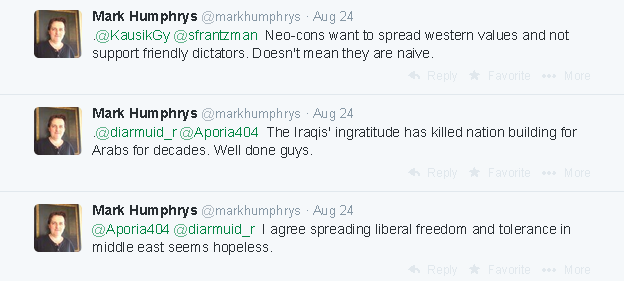
Pessimism:
My view
as at Aug 2014.
The Iraqis killed the dream that Arabs want to be free:
"The Iraqis' ingratitude has killed nation building for Arabs for decades. Well done guys."
The awful "Arab Spring" then finished the dream off.
"This is an amazing victory,
a victory over
a monster who gassed
civilians, jailed children, sent millions into fruitless wars, harbored
poisonous weapons to threaten free peoples, tortured thousands,
and made alliances with every two-bit opportunist on the planet.
It's a victory over
those who marched in the millions to stop this
liberation,
over the endless media cynics, over the hate-America
crowd, and the armchair generals. It's a victory for the two
countries in the world that have always made freedom possible
and who have now brought it to another corner of the world made
dark by terror. It's a victory for the extraordinary servicemen and
women who performed this task with such skill, cool, courage
and restraint. It's a victory for optimism over pessimism, the
righting of past wrongs, the assertion of universal truths against
postmodern excuses,
and of political leadership over appeasement.
Celebrate it. Don't let the whiners take this away from you"
-
Andrew Sullivan
(when he was good)
on the fall of Iraq, 2003.
"Let's get rid of them all"
- Tony Blair on the regimes of the unfree world.
"I will do whatever the Americans
want, because I saw what happened in Iraq, and I was
afraid."
- An unnamed dictator,
quoted by Silvio Berlusconi after the Iraq war.
It turns out
it was Gaddafi!
"Others understand the historic importance of our work. The terrorists know.
They know that a vibrant, successful democracy at the heart of the Middle East
will discredit their radical ideology of hate.
They know that men and women with hope and purpose and dignity do not strap bombs on their bodies
and kill the innocent.
The terrorists are fighting freedom with all their cunning and cruelty because freedom is their greatest fear
- and they should be afraid, because freedom is on the march.
...
I believe that America is called to lead the cause of freedom in a new century.
I believe that millions in the Middle East plead in silence for their liberty.
I believe that given the chance, they will embrace the most honorable form of government ever devised by man.
...
This young century will be liberty's century.
By promoting liberty abroad, we will build a safer world.
...
Like generations before us, we have a calling from beyond the stars to stand for freedom."
-
President Bush's speech,
Republican National Convention, Sept 2004.
It was not to be. But maybe a later leader will make it happen.