Not censorship
Actually, this page covers
things that
are censorship
as well as
things that are
not censorship.
As well as things where I am not sure.
This page is discussion of borderline cases,
hard cases,
conflicts of rights,
the definition of speech, the role of the law,
and so on.
I come down on different sides on different issues below.
And on some of them, I am not sure.
As an adjunct to the Anti-censorship page.
Privacy (published information)
Invading people's privacy can often be a form of
threat.
"Doxing"
and publishing the home address of
people involved in political controversy
is generally a type of
threat,
and an encouragement to others to target this person for
attack or hacking or
identity theft.
There are many reasons why people want privacy,
but one of the main ones is fear of predators
(burglars, thieves, stalkers, maniacs, terrorists)
that will come into our lives
and attack us, the more they know about us.
A terrorist-linked group publishing home addresses of political opponents and police
and prison officers
should clearly be illegal.
But, as always with speech, where do you define the line?
Some people use "privacy" to prevent people criticising them at all.
-
The child porn issue
can be considered on many levels other than obscenity.
It can be considered as a privacy issue.
It can be considered as an aiding and abetting crime issue
- by not handing over the photographs of crimes to the police.
- Also, filming any adult naked or having sex without their consent
should surely be illegal.
Those who do this deserve everything they get.
- There are also people who consent to privately film, but not publish.
Surely we can all agree that
"revenge porn"
should generally be illegal.
- But how about if the media merely tells the story
of some celebrity or political sex affair?
Under what circumstances should that be legal or illegal?
These questions are not easy.
The idea of a
"superinjunction"
in UK law
is an injunction against publication of something
where the
existence
of the injunction may not be reported.
The Elton John superinjunction of 2016 is a fascinating story.
A celebrity millionaire pays UK lawyers to try to use UK law to get a
celebrity sex story off the Internet.
Best of luck.
The story in Wikipedia:
Arguably the story is of public interest, since Elton John has worked to normalise
surrogate birth
and
gay parenting.
Even if the sex story is of little interest,
the censorship issue has become the main story.
We can all agree the secret is safe, whatever it is.
The Court of Justice of the EU,
in a ludicrous May 2014 ruling
in the
Mario Costeja González case,
decided that there is a
"right to be forgotten"
-
that almost anyone has the right to hide almost any information about them.
The EU tries to impose its more restrictive, Continental version of democracy and speech
on countries with a much freer tradition of freedom of speech.
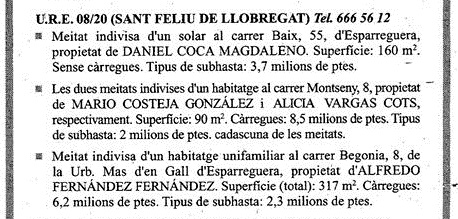
Spanish lawyer
Mario Costeja González
engaged in an epic legal battle to hide the above information.
He was unhappy that when you
Googled his name
you got a
1998 article
detailing his debts and the forced sale of his property.
He could not sue the newspaper
for printing facts,
so he chanced his arm and sued Google, and in a ludicrous ruling,
won in 2014 at the European Court of Justice.
Due to the Streisand effect, the above information will be
linked to his name
until the day he dies.
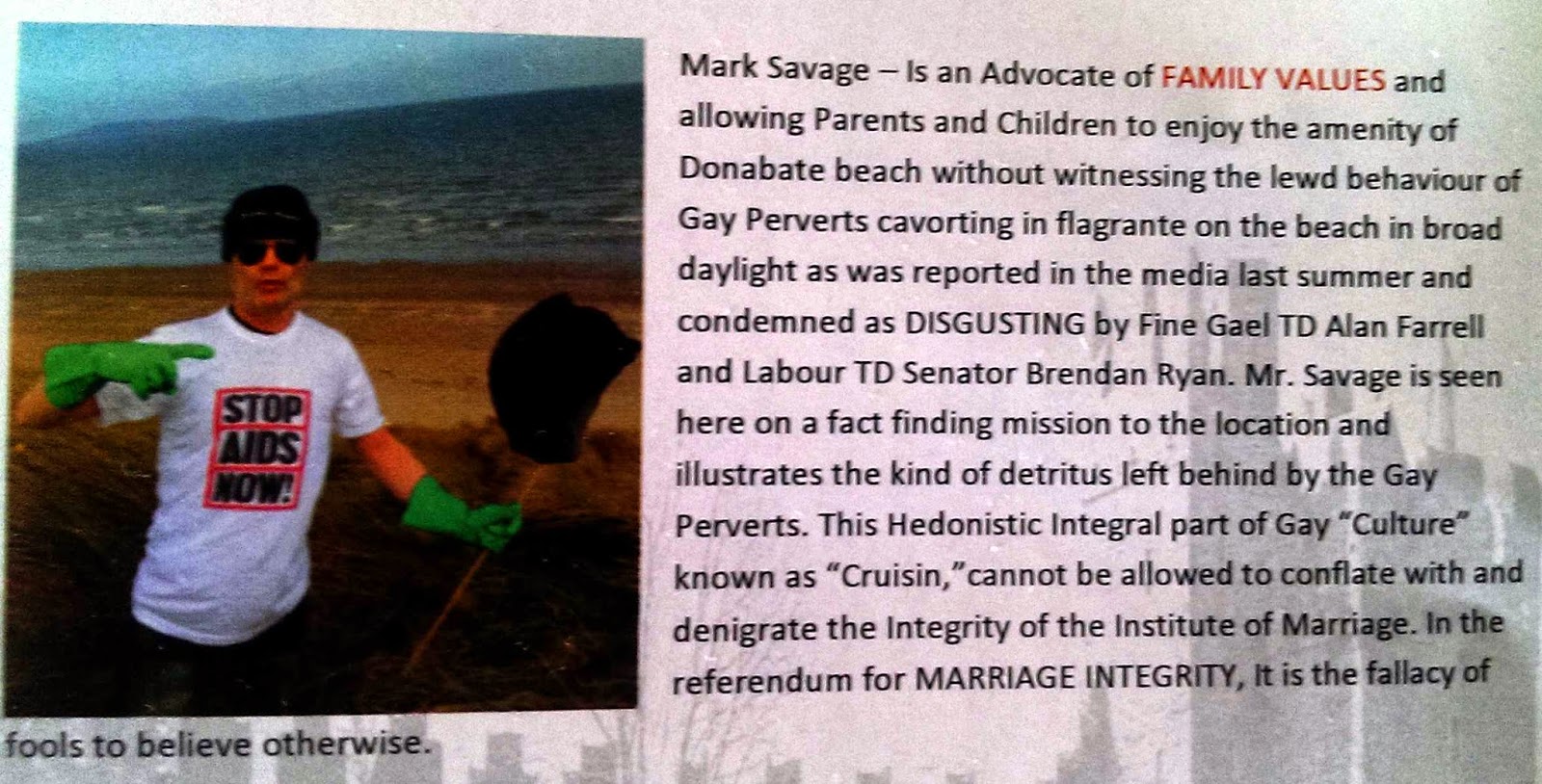
Mark Savage ran
in the local elections
in Ireland in 2014.
He ran as an independent
in Swords.
The above is election literature showing what he said about gays.
He objected to a
Reddit thread
slagging him off for it.
So he took a "right to be forgotten" case to ensure that
when you
Google his name
no one will ever see
the election literature
or the Reddit thread again.
Some private information is controversial
even if it is not being published.
Should the police, for example,
be allowed hold a DNA database of every citizen?
The classic civil liberties position has always opposed
DNA databases, compulsory ID cards,
and other information the police may collect on the citizenry
as a whole.
But perhaps their opposition is becoming misplaced.
Perhaps the proper, the honest, solution is to campaign freely and openly
for more liberal laws
(such as reforming the drug laws),
so that no citizen, now matter how deviant their lifestyle, has anything to fear.
Civil liberties groups evolved in a situation
where the state,
by repressing and oppressing in various ways
all sorts of
groups
- religious minorities, atheists,
controversial writers,
ethnic minorities,
gays,
unmarried mothers,
contraceptive users, drug users
- was the greatest threat to civil liberty.
But if all these battles are won (and I agree the drug issue remains outstanding),
maybe we should look again at the privacy of modern society
- which allows serial rapists, abusers, thieves,
muggers and burglars to operate uncaught
for years.
As conservatives have long pointed out, these people
are a threat to civil liberty too.
If there was a compulsory national DNA database,
rape (and rape murder) could become virtually impossible.
Even theft and burglary could be hard hit
- with the citizenry using their own home DNA kits to hunt for evidence.
So how about the following:
- A DNA database of all citizens.
- Tag all violent offenders for life,
so their whereabouts are always known (to a non-public computer).
You can still live, and do what you like.
All we ask is that we must know where you are.
- Or even tag the whole population, so it is known where everyone is.
Make assault, rape, abduction and murder literally impossible.
Maybe civil liberties groups have it all wrong.
Maybe this is the future of civil liberties -
the end of crime,
in a liberal, pluralist state.
In summary, if we ever do win the battle to create a proper liberal state,
then maybe we will eventually come to see privacy
as the greatest single threat to civil liberty.
This is a long way off perhaps, but it's still something to think about.
Hard cases - Speech that encourages threats to other people's liberties
The only reason we're in favour of free speech
is because we're in favour of freedom and liberty.
So how about when the
speaker doesn't believe in freedom and liberty
for others, and threatens them?
How about these hard cases:
- Intellectual arguments:
- A site that makes an intellectual case for
racism / fascism or
religious hatred.
- A site that makes an intellectual case for
bestiality.
Can such a case be made?
I'm not sure.
I can see that there is an argument
that this is not necessarily the same as supporting torture of animals.
After all, adult animals have sex all the time
(at least with each other).
See
bestiality laws.
- Anyway, how about a site that does
support torture of animals for sport or entertainment
- hunting, circuses, dancing bears, and so on.
- A site that makes an intellectual case for
pedophilia.
This is not necessarily a site supporting aggressive rape.
e.g. Say a site making an intellectual case
against the criminalisation of early- to mid- teenage sex.
- Writing that does openly support aggressive pedophilia,
including the rape of toddlers,
such as the writings of
Ayatollah Khomeini.
- A site supporting the
aggressive rape of civilians in warfare
(see also here),
or a site supporting
the killing of captured civilian women and children
(see also here).
- In wartime,
an intellectual argument supporting the enemy
(e.g. the Iraqi resistance,
or the IRA).
- Non-intellectual glamourisation of activities that threaten others:
- Almost every Hollywood action movie glamourises or condones
things that would, in real life, threaten other people's liberties:
- Car driving - If Hollywood car chases were true-to-life,
there would be dead passers-by in every film,
just as real-life police and real-life joyriders
do kill passers-by.
- Guns and fighting as a solution to all problems.
- Glamourisation of all forms of criminal abuse of others -
bank and
train
robbing, assault,
burglary, vandalism, arson, joyriding,
art theft,
kidnap, etc.
- all have been glamourised,
such as in the obnoxious The General.
Oddly enough, say, rape or child murder
is rarely glamourised.
- Glamourisation of
police brutality, lack of due process,
vigilante action, summary execution, etc.
- Glamourisation of
the DEA.
- Practical advice in general, "How-to" do something:
- A site that gives practical advice on guns, explosives, etc.
- A site that gives practical advice on burglary, lock-picking, etc.
- A site that gives practical advice on joyriding, speeding, car races, car chases, etc.
- A site that gives practical advice on rape.
- A site that gives practical advice on torture, for foreign police forces.
- A site that gives practical advice to pedophiles
- tells them where to meet children, etc.
- Real information:
- A site that tells motorists where speed traps are.
- A site that tells motorists where drink-driving checks are.
- A site that tells burglars what houses are empty,
where old people live alone, and so on.
- A site that tells loyalist paramilitaries
where Catholics live in each housing estate.
- A site that lists addresses of doctors that perform abortions.
- In wartime or in a time of genocide,
a foreign media site linked to the enemy regime
(e.g. Serb TV)
and perhaps helping organise the genocide (e.g. Rwandan radio),
or encouraging the enemy
(e.g. Arab TV,
jihadi videos on YouTube).
- In wartime, a home site
telling the enemy where military targets and informants are
(e.g. Wikileaks).
I'd like to say I have easy answers for all of these,
but I don't.
My instinct would be that
most of
1. and 2. have to be tolerated
as offensive speech,
whereas most of
3. and 4. cross the border into directly threatening people.
But I must say that it is hard to define the exact principles
I am using.
Avoiding offensive speech
While we might allow speech like that in
1. and 2.,
you do of course always
have the perfect right
to find the speech
disgusting,
and you should be able to filter it successfully
and completely out of your life.
Indeed, this applies to
any
speech you don't like.
Part of the problem
with offensive speech is that with many media, like
TV or the cinema,
we cannot run advanced
personal filters
- we simply have to sit there and get assaulted by what is coming next.
But this is a personal technology
problem,
not a legal problem,
and it can be solved by giving the individual
more technology
to put them more in control of their life.
- Libel can be tricky since one can be genuinely mistaken.
Or there can be a genuine dispute about what the truth is.
- Some forms of libel cannot be considered as free speech.
You cannot simply declare someone is a child abuser and say that is "free speech".
Especially if people believe it.
- People libel celebrities and politicians 24/7, but most of it has little impact.
Libels published online are often not believed and get little traction.
- Same with me.
Endless people
have libelled me
online, because they dislike my politics.
Almost none get any traction.
The one big exception being the libeller who started a
huge cancel mob against me with his libel in Nov 2021.
Such a fellow deserves to be sued in court.
The thing about noise is the
choice
of whether we
have to hear the speech or not.
You have the right to say what you like.
I have the right to filter your speech out of my life.
Speech is one thing, behaviour is another.
Do you have a right to speak in public
anywhere?
I support the right of political radicals and extremists
to their publications and web sites,
which we can all read in a non-threatening environment.
But as to whether they should be able to rally and march
down the roads of upset and intimidated residents
is quite another question.
Marches are behaviour, not pure speech.
Demos and marches
are an odd form of speech,
one that often interferes with those who do not want to hear it,
in a way that, say, websites don't.
It seems to me that
demos and marches
should be restricted to city centres, not residential areas,
unless there is some good reason why they have to go to a particular place.
Spam is not a censorship issue.
You can read all the ads you like at the spammer's site,
if you
choose to go there.
Spam is the enemy of free speech, by trying to destroy discussion groups and mailing lists.
Before 1992, I sent a few unsolicited messages myself.
It took some time for me (and others) to understand that this was a Bad Idea.
The Internet was quieter in those days, and no one complained to me or flamed me,
but I wish they had.
I should have realised sooner that unsolicited messages had no future.
Now there are hundreds of millions of people online.
If unsolicited direct-marketing commercial email is tolerated,
eventually everyone will be
receiving thousands or even tens of thousands of computer-generated email messages a day.
Already over 90 percent of email is spam.
Despite this,
spam is still legal in the US.
The only long-term solution is to make it illegal.
In the meantime, it is up to the Internet
to protect itself against these vandals.
Spam is the enemy of free speech
Just to be clear on that.
I
do support the government regulating the Internet
by making
direct-marketing email
illegal.
Spam is possibly the single greatest enemy of free speech on the
Internet today:
- It makes people not take part in discussion groups
for fear of sending their email address to spammers.
- It actually destroys the discussion groups
by filling them with spam, so everyone leaves.
- It makes people not put their email address on their web pages,
for fear of it being collected by spammers.
- It makes people run blacklists and filters on keywords
for their incoming email,
which may filter valid email messages as well.
I also would vote for making direct-marketing postal mail, direct-marketing telephone calls and direct-marketing faxes illegal.
By any reasonable standards of adult consent and privacy,
drug dealing should be legal
while direct-marketing should be illegal.
-
Warez
(pirated software)
is not a censorship issue.
You can get/buy the software at the author's site.
If you're shut down for spamming or uploading warez, I don't care.
- I also don't think
framing disputes
are a censorship issue.
Framing can enable one site to make
someone else's content look like their own.
In my opinion:
Linking is referencing, and is a right, with or without permission.
Framing is reproduction, and is not a right.
You have the right not to be framed if you don't want it.
- How to stop linking and framing:
- Of course, some people try to stop references to themselves
because, well, because they are mad:
- Jakob Nielsen
on the inanity of trying to stop people
deep linking
to your site
- and, even though they have
already indicated what they are interested in,
forcing them all to go to the front door and
dump them there to try and find their own way round.