I'm against the gangsters of
Sinn Fein-IRA,
but that doesn't mean I have much time for unionism.
As a southern Irishman, I have more in common with England
than with Northern Ireland.
England and the Republic of Ireland are both relaxed, liberal, secular states
where nobody cares what religion you are.
Northern Ireland is not like that, so it is more alien to me
than England is.
Though less alien now than during the Troubles, for sure.
I can relate to the Tories.
I find it hard to relate to the DUP or the UUP.
If unionists could embark on a secular, liberal project to make
Northern Ireland more like England,
I would support them all the way.
But 17th century religious triumphalism is just alienating.
There is nothing about an Orange march than can appeal to an outsider.
Unionists must abandon any taint of ethnic or religious supremacy,
and become secular and universal - like the English.
Certainly a secular, liberal case can
be made for the union.
The Holy Cross dispute, 2001-02.
Attacking 4 year olds going to Holy Cross primary school
sums up the lack of appeal of Ulster loyalism to outsiders.
This absurd bigoted protest makes sense to the
supremacist's mind,
but is utterly alienating to everyone else.
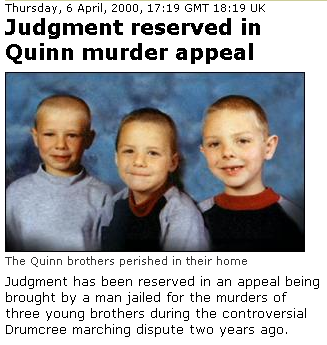
The killing of the
three Quinn children
in 1998.
Carried out by the UVF to help the
Christians of the
Church of Ireland
march down the Garvaghy Road.
From BBC.
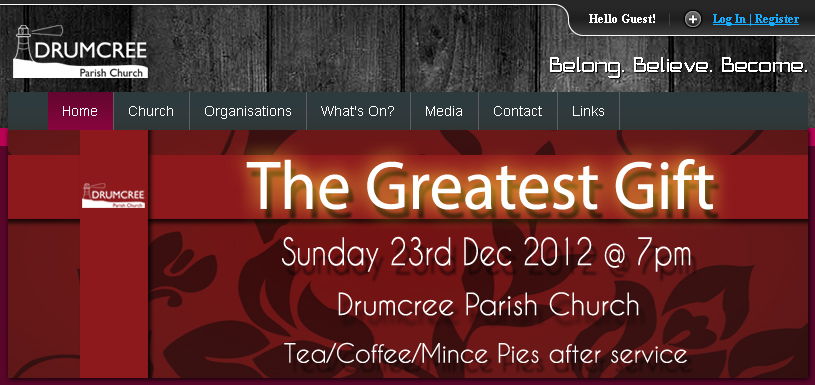
Drumcree parish church website today.
Em, shouldn't there be a memorial to the Quinn children on the front page?
There is in fact
no mention
of them on the site.
The UUP was the dominant unionist party in the 20th century (from 1921 to 2003).
It is the party that declined to develop Northern Ireland as a liberal democracy
but rather developed it as a majoritarian democracy,
with Catholics as
second-class citizens.
The UUP for decades had formal links to the
extremist anti-Catholic organisation, the
Orange Order,
though this now has ended.
The failure to woo the Catholic unionist:
NILT Survey, 2003:
Despite 21 percent of Catholics wanting to stay in the UK,
0 percent regard themselves as "Unionist",
only 1 percent voted UUP,
and only 1 percent voted DUP.
The cause is because the DUP and UUP do not make the effort to woo the Catholic
unionist vote.
Indeed, they often seem to do everything they can to alienate the Catholic unionists.
But the Catholic unionists' votes (perhaps 50,000 votes in all)
are there for the taking, if only the DUP and UUP
wanted them.
The Orange Order disagrees with Catholicism (don't we all)
but they go much further.
They embrace a virulent anti-Catholicism
that is more like anti-semitism
or racial hatred.
Apart from the long history of anti-Catholic violence
(and even killing)
linked to Orange marches,
there are explicit anti-Catholic rules.
Catholics are barred from membership.
Members of the order face expulsion for attending any Catholic religious ceremonies -
even a funeral.
Members are even forbidden to marry Roman Catholics.
No respectable person could be a member of this organisation.
The Grand Master, Robert Saulters,
attacked Cherie Blair
for her religion
in 1996.
He said
Tony Blair had
"already sold his birthright by marrying a Romanist and serving Communion in a Roman Catholic Church.
He would sell his soul to the devil himself."
The DUP was founded in 1971 and
led from then until 2008 by the hate preacher
Ian Paisley.
Paisley
disagreed with Catholicism (don't we all),
but not to promote reason,
but rather to promote his own brand of absurd superstition,
which includes creationism.
Paisley
spread anti-Catholic and anti-Irish hatred for decades.
He was a malevolent influence on the North,
encouraging it into hatred and civil war.
Paisley quotes:
Paisley
on the death of
Pope John XXIII
in 1963:
"This Romish man of sin is now in hell."
Note this is long before the Troubles even started.
Paisley on the Catholic church:
"She is the seed of the serpent, the offspring of Belial, and the progeny of Hell.
Her eye gleams with the serpent's light. Her clothes reek of the brimstone of the pit.
Her words and opinions label her the parrot of Beelzebub. Unhesitatingly I recognise as of her father the Devil,
and the works of her father she will do.".
Late in life, Paisley, like almost everyone else in NI, joined the Peace Process and compromised.
Paisley on the death of the Pope, 2005:
"We can understand how Roman Catholics feel at the death of the Pope and we would want
in no way to interfere with their expression of sorrow and grief at this time."
- Incredible.
This is the same pope he called the Antichrist.
Incredible how the prospect of power can mature some people.
In later years, and after Paisley's retirement and death, the DUP has become a more normal party.
Who would I vote for in NI?
I dislike every party.
SFIRA are terrorists.
DUP and UUP are slowly-recovering bigots.
SDLP and Alliance are sane but left-wing.
(Anti-Israel. Anti-American.)
Anti-Israel fanatic
Gary Spedding
is an Alliance Party activist.
I dislike every party, but I am happy for them that they have peace.
I wish them well.
Unlike the Israeli peace process, the Irish peace process actually worked.
"Antichrist! I renounce you and all your cults and creeds!"
- Ian Paisley yelling at the Pope
when he visited the
European Parliament
in 1988.
Irish nationalists often assume that the island of Ireland
is a natural political entity, and should be a country,
and it is "artificial" to partition it.
Let us look at how one can define the borders of any of the countries on earth
in the first place.
The fact is there is no set of formal principles whereby
one can define the borders of the countries of the earth.
The principle of "self-determination" of a people is too vague.
What size people?
How large does the group have to be before they get self-determination?
What if they live intermingled with another group that also deserves self-determination?
Even if one can identify a group that deserves self-determination,
how does one determine the territory?
Does the group have to be a majority in all parts of the territory,
or only a majority overall?
If only a majority overall, there are lots of pieces around the edge of the territory
that could easily be included or not included on whim.
There is no way of deciding.
Consider this thought experiment (Not my idea - I heard this somewhere):
If there was a land bridge between Ireland
and Scotland (as there was in the past),
we would have to draw the border somewhere on the land.
It would probably be drawn not far from where it is,
and it would be accepted.
People - especially in the South - would be far more relaxed about it.
It is the fact that Ireland is an island
that makes one think the border should be at the sea.
But this is not really logical.
What I am making are the following points:
There is no a priori reason why the border can't be roughly where it is,
rather than at the sea.
In other words, the island of Ireland is not an indivisible unit laid down by God.
Partitioning the island is no more "artificial" than partitioning Europe.
However, we must accept that all borders on earth will be somewhat random.
All countries on earth will "capture" populations that could easily be part of
another country.
People will for random reasons be caught on the wrong side of the border
from their point of view.
Therefore, the only solution to this is that
it should not matter what side of the border you are caught on.
All countries on earth should be ultra-neutral, secular,
liberal democracies where all minorities
feel like first-class citizens.
Countries should not try to stand for a
common culture, heritage, religion or beliefs.
The state should be neutral about such things.
A Catholic trapped in the North
- or Anglo-Irish trapped in the South -
should feel only modest disappointment,
but no real effect on their daily life.
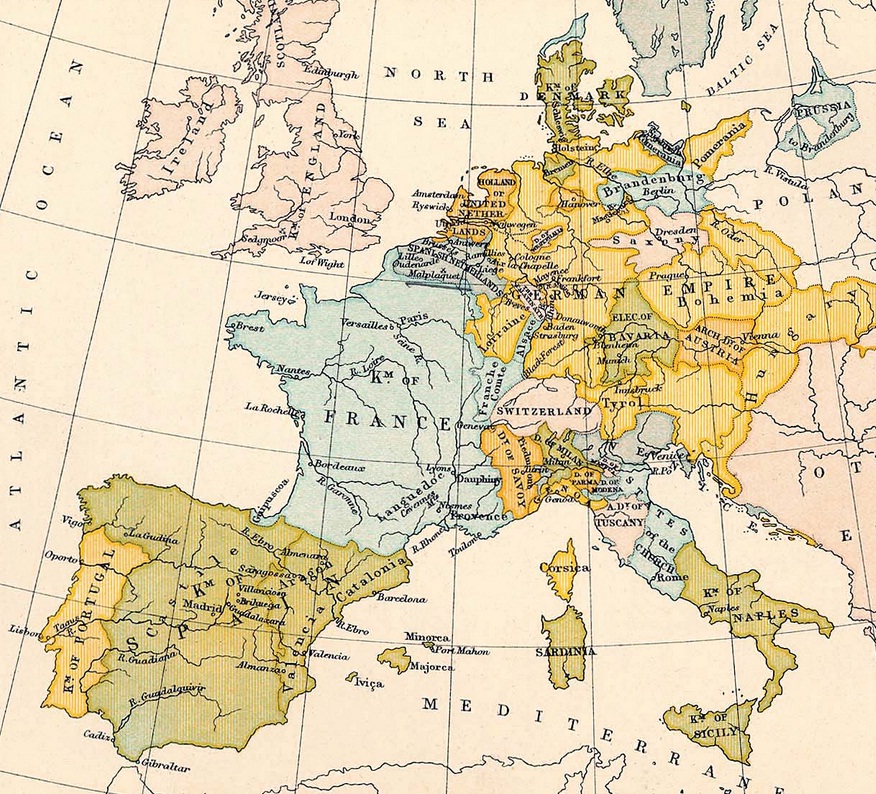
Map of Europe in 1700.
Please define what the borders in central Europe should be.
The fact is, there is no set of formal principles whereby one can define the borders of the countries of the earth.
From here.
The loyalist paramilitaries
did not serve the role of the
IRA's enemy in war.
The British security forces filled that role,
and fought
according to the rules of war.
The loyalists did not fight
according to the rules of war.
They killed almost
exclusively
innocent civilians,
and not by accident either.
These were not errors.
These were not "collateral damage"
- they were the
actual targets.
The loyalist paramilitaries
were
Protestant religious death squads -
killing and torturing innocent, uninvolved
civilians for religion.
We were supposed to believe that both sides were doing this of course, but in retrospect
that was unthinking politically-correct humbug,
one of many such devices over the last 30 years
to avoid thinking about the conflict.
Anti-Catholicism has been just as real in Britain's history
as anti-semitism has been in Europe's,
and it could so easily have ended in the horrors of the camps
(as have in fact been proposed by a number of loyalist thinkers).
The similarities of virulent fundamentalist anti-Catholicism and anti-semitism:
The "Irish" problem, like the "Jewish" problem,
was never a problem with the Irish.
It was a problem with virulent fundamentalist anti-Catholicism,
a problem that still exists in the unionist population today.
Northern anti-Catholicism is the fundamental cause of 30 years of conflict.
The similarities of the loyalists and the Palestinians:
Loyalists have killed and tortured almost
exclusively
random Catholic civilians.
This is because they are motivated by a fundamental racism
that their opponents do not feel.
Any objective historian will be struck by the fact that,
like in the
Israeli-Palestinian conflict,
the republicans generally tried to hit military targets,
while the loyalist supporters would cheer the killing
of any random civilian.
To observe this does not mean one supports either the republicans
or the Israelis.
It is to observe that fundamental beliefs come out
in the way one wages war.
It is hard for an Irish person to recognise that
anti-Catholicism
did once have some rational origin
(at least, more rational than anti-semitism).
In the 16th, 17th and 18th centuries, England
and other Protestant countries were constructing the most
exciting centre of civilization and science
since Ancient Greece.
They were building the modern world of science, democracy
and capitalism.
Catholic Europe
threatened to destroy their world,
and put it again under the control
of the Pope and his medieval church.
Britain was right to fear Catholic Europe,
but absolutely wrong to
introduce persecution of its own Catholics
as a response.
Irish Catholics were reduced to impoverished serfdom
and regular famine,
and anti-Catholicism
mutated into a fantastic creed similar to anti-semitism.
Indeed, if anything, persecution of Catholics got worse
as England's power and security grew
(e.g. the persecution of
Irish Catholics
after Protestant England's final and total victory in 1691).
It is similar to the Islamist
threat to the West today.
The West is the heart of human civilization and knowledge.
The Islamists threaten to destroy it all
and return us to medieval barbarism.
We are right to fear them,
but would be wrong to
introduce persecution of our own Muslims.
To a rationalist, it is absurd that Protestant religious killers should hate Catholics,
who share identical beliefs,
more than they hate, say, atheists.
But strangely enough this is what you would expect if you view religions
as competing
memes.
I don't happen to think that Christianity (whether Protestant, Catholic, whatever) is remotely true,
or has got any kind of real understanding of the nature of our universe,
but is it perhaps good for society anyway?
It has inspired many good things and many good people, to be sure, but it has a lot to make up for
since it has also inspired great evils such as medieval witch-killing and modern day loyalism.
In general, its moral superiority over the
paganism it replaced
or over modern day
atheism must remain unproven.
Northern Ireland is a place that has far, far too much Christianity.
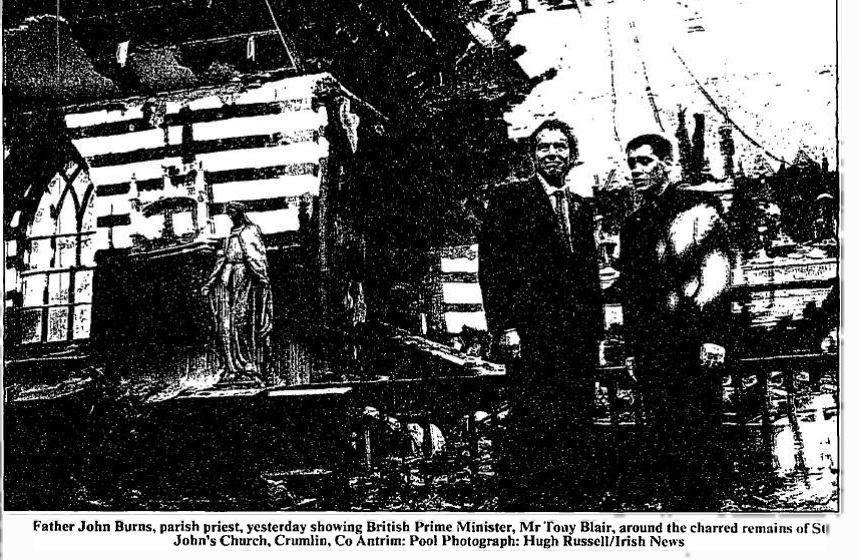
Arson attack on Catholic church in NI in 1998.
From Irish Times, July 3, 1998.
A leaflet distributed at Drumcree
approved of the church burning.
The leaflet quoted from
Deuteronomy 7,
which, they are correct in claiming, fully supports such activities:
"This is what you are to do to them: Break down their altars, smash their sacred stones,
cut down their Asherah poles and burn their idols in the fire."
For many similar quotes from this unpleasant book
see here.
In fact,
Moses
would have supported burning both Protestant and Catholic churches,
since he would have regarded Christianity as a heresy.
It is obvious that Moses would have regarded
Jesus
as a false prophet,
and would have had him put to death.
I'm sure he would have approved of the crucifixion.