The solution to the original pre-1922 Irish problem,
and the modern
Northern Ireland problem,
and almost every conflict in the world,
is the same:
Every country should tolerate diversity.
Every country should be a secular liberal democracy.
Every country should be a happy place for minorities.
Being a minority should never make one feel like a lesser citizen.
Countries should resist the impulse to impose a majority culture or religion.
Protestant rule and
Catholic rule and
Islamic rule
should be resisted.
Gaelic history and British heritage can be celebrated but should not be imposed.
Those who wish to dissent should be able to.
OK let me give my background so you can dismiss me.
I am from a Catholic, nationalist, political, southern Irish background.
When I was young I left Catholicism
and indeed Christianity.
Since the 1980s I have been an atheist.
I married an English Protestant.
I admire science and the Western Enlightenment.
I love Ireland,
but I do not identify primarily with Ireland.
I identify primarily with the West.
I support all democracies against non-democratic enemies.
I support the front-line western states (America, Britain and Israel)
against enemies of the West such as Islamists and jihadists.
I reject any anti-western
model of Ireland,
like the models of Eamon de Valera,
Michael D. Higgins
and Gerry Adams.
Now we can begin.
My grandfather fought in the GPO with Pearse in the 1916 Rising.
My granduncle was the first President of Ireland.
My great-grandfather was a Home Rule MP, Sinn Fein TD, and a Member of the First Dail.
My great-granduncle founded the Irish Volunteers and died in action in the 1916 Rising.
My great-great-grandfather was a Home Rule MP and a nationalist High Sheriff of Limerick.
My great-great-great-grandfather was a Home Rule councillor and a nationalist High Sheriff of Limerick.
Should Southern Ireland be independent at all?
- It is such a cliché that Ireland was an abused colony,
and indeed most Irish people think of the past as "colonial",
that it is sometimes a shock to realise that Ireland was not meant to be regarded as a colony at all,
but as part of the nation.
The 19th century is full of well-meaning attempts to make Ireland look
as much a part of the national landscape as Scotland.
And, in an alternate history, it could have worked.
Even as late as 1914, the UK might still have been saved.
For Ireland really was (and still is) a fundamental part of English and UK history,
in a way that many Irish people deny.
Irish blood has flowed in the veins
of many people, from the English Royal family downwards,
who have shaped the past and present of the English state.
Henry VIII,
Elizabeth I,
James I,
William of Orange,
Charles James Fox,
Queen Victoria,
Lord John Russell,
Lord Frederick Cavendish,
Arthur Balfour,
Winston Churchill,
Sir Anthony Eden,
Sir Alec Douglas-Home,
Lord Cranborne,
David Cameron,
Queen Elizabeth II,
Prince Charles,
Lord Mountbatten,
Princess Diana,
Sarah Ferguson
and
Camilla Parker-Bowles
all descend from Brian Boru, High King of Ireland.
And English blood has always flowed in the veins of
Ireland's great families, including many of its great rebels.
Garret Mor Fitzgerald,
Garret Og Fitzgerald,
Silken Thomas,
The rebel Earl of Desmond,
The rebel Earl of Tyrone,
Lord Edward Fitzgerald,
Robert Emmet,
Daniel O'Connell,
William Smith O'Brien
and
Charles Stewart Parnell
all
descend from the British Royal Family.
Even
early 20th century Irish nationalists and politicians -
Mary Spring Rice,
Sir Thomas Esmonde
and
Dick Spring -
all have Royal Descents.
Gerry Adams, Bobby Sands and John Hume are obviously British
in their ancestry.
Of course, in Ireland,
all of our ancestors in every line
came from Britain, if you trace the lines back far enough
(except for the very small number that came direct from the Continent).
The UK could have worked,
but the whole population had to be brought on board
as first class citizens.
The Catholic majority of the Irish population
had spent the 19th century recovering
from their dispossession,
the theft of their land,
and the long systematic denial of Catholic rights to property,
education and professional membership
- and, when they finally reached the middle class in the late 19th century,
voted immediately for Home Rule and, eventually,
for independence.
The 19th century failure to save the Union
The denial of Home Rule in 1874 to 1916 was a great tragedy, for Ireland as well as for the UK.
In that period,
Britain was a flawed democracy,
and Irish people had a vote,
but British rule of Ireland was fundamentally not democratic.
The Irish never voted to join the Union in 1801,
and when they were, in the late 19th century, finally allowed the vote,
they voted again and again to leave.
But they could not vote to leave -
they had to wait until parliament allowed them to go.
Britain was a proto-democracy that slowly evolved into a real democracy.
The first truly democratic (large numbers of voters, all religions, secret ballot)
election in Ireland
was held in 1874,
the first chance that the natives
ever had
in 300 years
to say what kind of society they wanted.
It was a triumph for democracy after centuries of coercion.
And the will of the people was quite clear and understood.
It should have been a final, peaceful end to
the long sordid story of disenfranchisement.
But instead,
the results of that election, and all subsequent elections
in the following 40-50 years,
were overruled by London.
Having been finally granted the vote,
the Irish people now found that the vote was of limited use.
Yes, in 1874 to 1916, Ireland got much richer, it got land reform,
and Irish nationalists (including my family) took over most local government.
English politicians did try to get Home Rule through
but failed.
Finally, only by the violence of the
1919-21 IRA
could the democratic will of the people,
expressed in elections for decades, be finally implemented.
It is good that the will of the people finally got expressed,
but for me (and I feel this more and more as I get older)
it wasn't worth killing people for,
not to mention
the unforgivable destruction of Irish heritage.
Ireland will never recover from the violence of 1916-23.
The Famine, 1845-50:
The Famine
is the defining moment in the history of Anglo-Irish relations.
The fact that this could occur
in what was then
the richest country in the world
is all you have to say to justify Irish independence.
Violence against the UK in 1916 seems morally unjustified.
But I would not say that about violence against the UK in 1846.
The Famine was ancient history by 1916:
On the other hand,
it can be argued that the Famine was largely irrelevant history
by the end of the 19th century,
when Ireland was booming due to Britain's imperial boom.
By 1914, Ireland was a completely different country to what it was in 1850.
Ireland was the 7th richest country in the world in 1871.
Britain was 1st.
Ireland was the 11th richest country in the world in 1911.
Ireland went into an economic slump after
(i.e. caused by)
independence,
and fell far down the world ranking.
It never achieved this
(you might say its natural)
world ranking
again until the Celtic Tiger of the 1990s.
Rising tide lifted only some boats
by David McWilliams, points out some facts:
In 1913 Ireland was as rich as Scandinavia.
In 1986 Ireland was only 1/2 as rich as Scandinavia.
Self-determination and democracy
are only means to an end.
What is important is:
(a) prosperity, and:
(b) a free society, with human rights and civil liberties.
By this standard, Ireland's independence
was a backward step,
because:
(a) Ireland became poorer,
and:
(b) Ireland became less free
as Catholic law was introduced.
The 20th century tragedy of independence
Ireland's independence was a mess.
It caused the Civil War,
the
destruction of the Public Record Office,
partition,
a sectarian Catholic state in the South,
and a sectarian Protestant state in the North.
Certainly you can blame Irish and British unionists for blocking the Home Rule
that was the clear will of the people.
And maybe you can blame the Irish nationalists for not waiting another generation,
and for turning to violence in 1916.
I think both sides are to blame.
Both sides were democrats who believed in some form of democracy.
They should have been more reasonable.
Maybe it's time we stopped glorifying unelected, revolutionary violence.
Ireland is far, far greater than that.
Ireland was poor compared to Britain in 1900, but actually richer than a lot of Europe,
and so one of the richest places in the world at that time.
From 2018 paper.
Uses modern boundaries.
Discussed here.
The song
"James Connolly"
by
The Wolfe Tones
shows
the lack of a sense of proportion of many Irish republicans.
The lyrics are completely over the top:
"God's curse on you England, you cruel hearted monster;
Your deeds they would shame all the devils in hell".
The most evil deeds ever?
What did England do?
They executed a wounded rebel fighter,
James Connolly,
a man who had just
killed 116 soldiers and 16 policemen.
Are Connolly's victims not human too?
Couldn't their families sing a song about James Connolly
as a "cruel hearted monster"?
Irish republicanism is a legitimate philosophy, but it badly needs a sense of proportion.
The Irish Times and the Irish Independent
supported the
execution of the 1916 leaders.
(Left) The Irish Times,
May 10, 1916,
after most of the leaders have been executed,
supports further executions.
(Right) The Irish Independent,
May 10, 1916, also
supports further executions.
James Connolly was executed on 12 May.
In our glorification of 1916 violence,
we have lost touch with the world view
those newspapers represented.
But reading their editorials is not a look into madness.
It is an alternative view, one that has been wiped out of Irish history.
Party
Votes
% Votes
Seats
% Seats
Sinn Fein
476,087
46.9
73
69.5
Irish Unionist
257,314
25.3
22
20.9
Irish Parliamentary
220,837
21.7
6
5.7
Labour Unionist
30,304
3.0
3
2.8
Independent Unionist
9,531
0.9
1
0.9
The results
of the 1918 election,
the Sinn Fein landslide,
are more complex than people think.
Nearly 30 percent
(29 percent) of the island of Ireland voted for continued Union.
Sinn Fein did not
actually
win a majority of the votes.
It only won 47 percent.
Ireland has reformed
The Irish problem has always been, and is today,
basically a simple problem,
about the nature of
disenfranchisement.
The problem lasts as long as the disenfranchisement lasts.
The question of nationality is only secondary
(as is shown by nationalist enthusiasm for the modern
power-sharing settlement in NI).
Having your own nation may or may not be a good way
of achieving a free and equal society.
You may trade the hostility, prejudice and thoughtlessness
of your foreign rulers
for a new set of home-grown,
tribal majoritarian oppressions,
as southern Ireland did for many years.
But southern Ireland is a much better place now.
It is a proper liberal democracy,
where everybody is a first-class citizen -
even secular atheists like me.
It has abandoned the insane ideas of protectionism
and self-sufficiency,
and embraced global capitalism,
becoming one of the richest countries in the world,
with strong ties to America and Europe.
It can even begin to think again of Britain as its "sister country"
without recoiling from the term.
Northern Ireland in 1967, like the UK in 1915,
was a deeply flawed democracy
against which Irish nationalists had genuine complaints.
Whether those complaints ever justified killing anyone is a different question.
I think not, for both times.
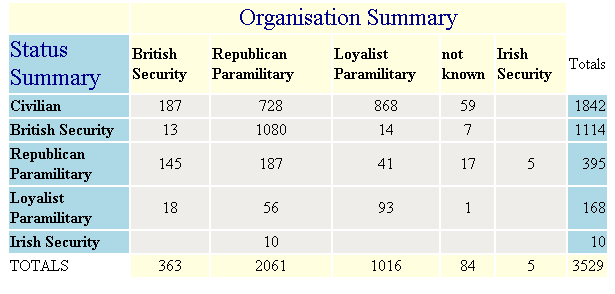
Who did the killing (excluding the unknowns).
Pie chart made here.
Who did the killing.
From here.
See discussion of the
different stages of the Troubles.
For most of the individual years of the Troubles,
Republicans were carrying out 70% of the killings. Some years 80%.
It's hard to know what the long-term future of the North is.
On the one hand, southern Ireland seems more emotionally attached to the North than Britain.
Britain emotionally abandoned Northern Ireland long ago,
regarding it more as a "white man's burden" than as part of their country to be defended.
The inability of the Ulster unionist to win the hearts and minds of Britain
is shown in opinion polls.
All during the Troubles,
polls (see below) showed that
more Britons wanted a united Ireland than wanted NI in the UK.
The Republic of Ireland, in contrast, has made no such abandonment,
and continues to regard Northern nationalists as fellow countrymen.
So one might think the future of the North is with (a reformed) Ireland.
On the other hand, peace and power-sharing seem to have ended
the urgent desire of northern Catholics for a united Ireland.
There has been a major shift in polls during the Peace Process,
where now
only a bare majority (in some years a minority)
of NI Catholics want
a united Ireland. See below.
It may be that there would be an
economic cost
to a united Ireland, since Dublin could not afford the subsidies that London can.
This would put off northern Catholics,
and also (even more) put off Southerners.
Southerners would also not vote for any arrangement that would start up the Troubles again.
If a united Ireland means a violent loyalist uprising,
Southerners will vote no.
Far better to keep the current arrangement.
So power-sharing may be here to stay.
Northerners seem to like power-sharing.
One now imagines that if
there ever is a majority vote for a united Ireland,
that power-sharing will still not end.
First, to provide security for unionists,
but secondly,
because nationalists, having tasted power and worked successfully with the unionists,
will not want to give up power to Dublin either.
Whether within Ireland or the UK,
power-sharing Home Rule for Ulster will continue forever.
The Peace Process
has been painfully slow,
but so far the optimists have been right.
The republicans really are willing to compromise.
They have finally stopped the war.
The unionists really are willing to compromise.
They are willing to share power with Catholics,
even if they don't express enthusiasm about it
and rarely seem to have a positive vision for the future.
There's a long way to go.
But isn't this better than the war?
Sinn Fein triumphant:
After the Peace Process, I thought SFIRA would fade away.
Their rise has been depressing.
And they can be very triumphalist.
But it is important to remember the facts.
Sinn Fein are a large party in a splintered landscape.
In the 2024 UK election in NI,
Sinn Fein got 27 percent of the vote.
73 percent of voters did not vote for Sinn Fein.
In the 2024 Irish election,
Sinn Fein got 19 percent of the vote.
81 percent of voters did not vote for Sinn Fein.
While SF overtook the SDLP, the nationalist vote as a whole has not made progress.
The unionist vote has declined, but not to nationalists.
Rather to the middle ground.
British attitudes towards NI over time.
For a long time, a majority of Britons have wanted to be rid of NI and its Troubles,
irrespective of how NI unionists feel.
The major change of recent years is that
the Peace Process has made Britons happier to keep NI within the UK.
Graph from here.
For nationalists, the partitionist settlement of the GFA
is about building a modern, liberal, neutral state
that everyone can belong to.
This is what every country in the world should be anyway.
Whether this will ever lead to a United Ireland may not matter.
Only 64 percent of Catholics regard themselves as "Nationalist".
Only 66 percent of Protestants regard themselves as "Unionist".
Voting.
Despite the above interesting signs, voting for the four big parties is entirely sectarian.
Only 1 percent of Catholics voted DUP.
Only 1 percent of Catholics voted UUP.
Only 1 percent of Protestants voted Sinn Fein.
Only 4 percent of Protestants voted SDLP.
The only party to get large numbers of both religion is Alliance.
The number of nationalists in NI has not grown.
NILT opinion polls over time.
Graph from here.
The Peace Process has not led to any great desire for a united Ireland.
NILT opinion polls over time.
Graph from here.
Among Northern Catholics, enthusiasm for a united Ireland has declined not risen.
The major change of recent years is that
the Peace Process has led to Catholics becoming much happier within the UK.
NI opinion polls, of Catholics only.
Graph from here.
Independence was not a success for the Irish economy.
De Valera and others adopted bad ideas (like protectionism)
that hurt Irish growth.
Only when Ireland adopted free market ideas, free trade, globalisation
and low corporation tax
in the late 20th century
did the Irish economy become a huge success.
Stats from Angus Maddison.
The Republic has abandoned two major
principles of the revolutionary Irish (de Valera) state:
(a) a Catholic state, and:
(b) protectionist, self-sufficient,
nationalised-industry economics.
It is now
secular, and
capitalist.
Now is time to abandon a third principle:
(c) neutrality.
It is time for the Republic to become
a formal ally of Britain (and the US).
In the Iraq War,
the brave decision
of the Fianna Fail / PD government
to keep Shannon Airport (and other Irish airfields and airspace)
open to the Allies,
even in the absence of a UN resolution,
was a welcome step in this direction.
In the future we should
go further and declare Ireland a formal ally
of Britain and America.
They did not fight in WW2, the Cold War,
or the liberation of
Iraq and Afghanistan.
They are peacekeepers, and a police force.
They have done much noble and heroic work
(e.g. defending the state against the IRA).
But the politicians
will not allow them actually
fight with our democratic allies.
UNIFIL in the Lebanon
is the only engagement of the Irish army that I think is actually
harmful and should stop.
Kevin Myers, January 15, 2009, nails Irish neutrality:
"Begging your pardon, ma'am, but I don't call an inability to defend a single beach, or guard a cubic meter of airspace, 'neutrality'. I call it military dependency."
Kevin Myers, 15 Feb 2013, welcomes the historic joint British-Irish mission against the Islamists in Mali:
"From Nigeria to Somalia, throughout the Arab world, and on either side of the Hindu Kush, armed Islamism is resurgent. Ireland is now taking its place in the line in the great war of values, which was formally declared on 9/11. NATO chief Anders Fogh Rasmussen says he would welcome Irish membership of NATO. So would I.
An informal US base already exists in Shannon, and the US is our largest foreign investor. It's time to affirm that relationship with a binding treaty".
Famous speech given in 2003 before the invasion of Iraq, by
Colonel
Tim Collins,
from Northern Ireland.
Re-created here by Kenneth Branagh in
BBC drama
10 Days to War (2008).
Extract from his speech:
"The enemy should be in no doubt that we are his nemesis and that we are bringing about his rightful destruction. There are many regional commanders who have stains on
their souls and they are stoking the fires of hell for Saddam. He and his forces will be destroyed by this coalition for what they have done. As they die, they will know their
deeds have brought them to this place."
I would prefer Ireland to be linked to the Anglosphere
than to
the EU
or
the UN.
Post-colonial U.N. crutch
by James C. Bennett
describes how I feel about the past and future of Ireland:
"It was natural for countries emerging from colonialism to a shaky independence to turn to their U.N. memberships as a source of pride, legitimacy, and often scarce revenue.
... However, the next generation rising up in the nations of the wider Anglosphere, like India, are beginning to take a less romanticized view of their fathers' commitments. Taking their independence for granted, they are able to contemplate closer ties to America and renewed cooperation with Britain on their own merits,
more free from the burden of past events."
"Often Anglosphere ties in these nations are the tolerant, outward-looking, freedom-oriented option, in contrast to more inward-looking nationalistic visions based on Continental European-style blood-and-soil ethnic nationalism."
In other words, the future for Ireland
is not Sinn Fein nationalism and UN third-worldism,
but rather Ireland as an independent, respected,
trustworthy ally of Britain and America.
The Presidential standard.
Maybe this should be the new Irish flag.
The
Tricolour
symbolises two tribal, sectarian traditions
and a pious declaration of "peace" between them.
It is a symbol of division if anything.
And the unionists have never been impressed by this declaration of "peace".
Maybe, as we redefine a secular, free market, pro-West, and possibly re-united, Ireland,
we should switch flag to something like the Presidential standard.
Another possibility would be
St Patrick's Cross
(which became part of the Union Jack).