I'm against most things the Greens say
about biotech, agriculture, genetics and medicine.
Much of it is provably false.
The Green movement is largely a movement that does not believe
in science and reason,
and often even explicitly rejects it.
I'm sceptical about their claims of looming apocalypse
due to climate change or population growth.
The threat of apocalypse due to
nuclear-armed communism
seemed real to me.
Apocalypse due to
nuclear-armed Islamism, or other future tyranny,
seems real to me.
Apocalypse due to peaceful consumerism seems far-fetched.
There might be climate change issues in the future,
but whether they will be apocalyptic I am not yet convinced.
We shall see.
I'm against almost everything the Greens say
about economics, trade, war, terror and international politics.
That's because it's just standard socialist nonsense.
I very much support
preserving old buildings,
and preserving old streetscapes,
and preserving endangered species, but I'm afraid that
much of the other things the Greens campaign for leave me cold.
Many of the Green campaigns look to me
driven by a fear of wealth, science, technology and knowledge,
and a preference for mysticism, ignorance and
New Age mumbo-jumbo.
The green and the blue, Roger Scruton, 17 December 2011, asks why all Green parties have to be left-wing.
"when the environment came to the top of the political agenda I allowed myself [to] hope ... If the intellectual class is talking of conservation, stewardship and the duty to future generations it could not be long, I felt, before its members would see the point of
Burke's
argument, that society is not a contract between the living only, but a bond between the dead, the living and the unborn. They would surely allow themselves to recognise the
effect of socialism on the natural environments of
Russia,
Eastern Europe
and China
and of uncontrolled immigration
on the urban environment of Britain and France. They might even begin to acknowledge the work of the romantic Tory
John Ruskin
and his many disciples in saving the English landscape from destruction during the 19th century. And how can they consider the history of this matter without recognising that there has been, at every point, a battle between civil society and the state, with the 'little platoons' of home-loving volunteers on the side of conservation, and the great machine from elsewhere, often programmed with socialist software, scraping away our settlements and habitats, for the sake of goals that nobody understands and few people want?"
"Well, it didn't happen. The environmental agenda was confiscated by the radicals, wound into the old socialist grievances, and made into a badge of left-wing membership."
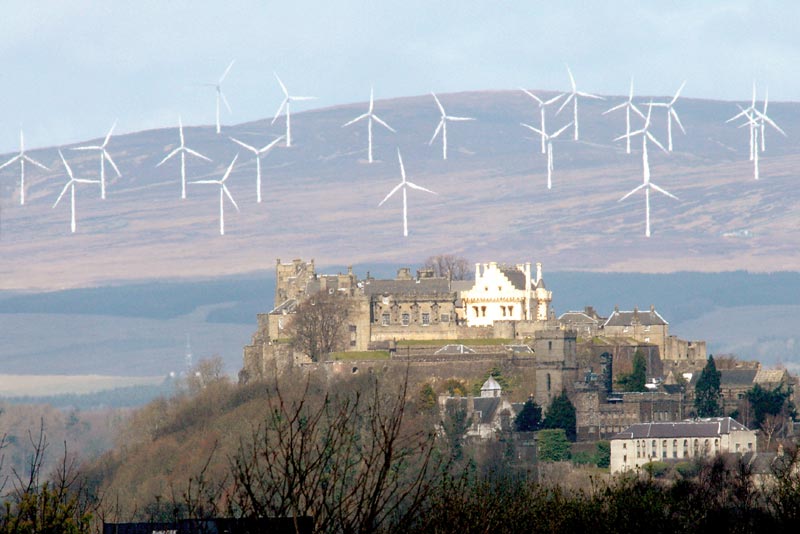
Wind farm destroys the environment at
the ancient
Stirling Castle in Scotland.
Image from here.
Search for more.
This is real destruction of the environment,
as opposed to the imaginary or theoretical
destruction of the environment
that
the wind farm is meant to save us from.
History of medicine
and its struggles against the superstition of religion.
The story continues today in its struggles against the superstition of the greens.
I'm not opposed to
animal rights.
I would grant a sliding scale of rights to human unborn,
primates,
and higher animals.
But one must recognise that the use of animals in medicine
is a great social good, saving thousands (maybe millions)
of human lives.
(And, incidentally, animal lives
- where do you think vet treatments come from?)
What exactly can be done with animals can be debated in each case,
but it is an issue that should be resolved by
democratic debate, not by violence.
Anti-GM activists in the West
are the fat, rich
enemies of the Third World.
They have a long record of
preventing food getting to starving people throughout the Third World.
Golden rice
- Anti-GM campaigners block GM rice developed to combat
vitamin A deficiency,
which kills 1-2 million every year,
and leaves 500,000 people blind every year.
It was developed in 2000 but is still not available to the third world,
due to green extremism.
Anti-GM campaigners may have the blood of millions on their hands.
The idea of "food miles"
sounds like a reasonable concept, doesn't it?
Surely it is worse for the environment to ship in food from abroad
rather than buy locally?
Maybe not.
See
Criticism.
There are many reasons
why buying local produce may be worse, not better, for the environment.
For example, fruit grown in the open in sunny climates, and then shipped to northern climates,
is likely to have a lower footprint than fruit grown inside heated greenhouses in unsuitable northern climates.
This is basically the issue of
comparative advantage.
Incredibly, even lamb raised in New Zealand's more suitable environment and shipped to Britain
may produce less emissions than buying lamb from Britain.
(Apparently because animals in New Zealand can graze outside all year round,
with no artificial feeds needed.)
Vegetarianism and veganism make some moral sense,
but it's hard / impossible to fight evolution on this one.
Nature evolved us as animals (exploiters of plants)
and predators (exploiters of animals).
It's not our fault.
Not respecting this in
children
in particular
can be a form of child abuse.
There is hope though:
In vitro meat
- meat grown from cells in the lab without being part of an animal.
Also called "cruelty-free meat".
When this technology is mature, I will eat this and nothing else.
The Reign of Recycling by John Tierney, Oct 3, 2015.
Some recycling makes economic or environmental sense, some is pointless
and some is actually bad for the environment.
But it is not about logic:
"It makes people feel virtuous, especially affluent people who feel guilty about their enormous environmental footprint. It is less an ethical activity than a religious ritual, like the ones performed by Catholics to obtain indulgences for their sins."
Cool It (2007)
argues that global warming is happening,
but is probably not the end of the world,
and we can deal with it through science, technology and reason.
Review of the book
makes a great point about how the left used to want people to be prosperous:
"It was not that long ago that the main complaint of left wing critics of the American economy was that it produced poverty and appalling social conditions. "Capitalism" was simply a code word for the rich getting richer and everyone else getting poorer.
... while the original critique was flawed, the sentiment was one of generating wealth for average Americans. Even as late as 1962 .. this sentiment still dominated left wing politics. How things have changed.
Today, the political left is "green" and their main complaint is not that capitalism produces poverty. They know capitalism produces affluence. And they oppose it. Americans, they complain, consume "too much" and need to make do with less, because the planet is threatened ... Global warming is only the latest of their concerns, having replaced the completely discredited 'population bomb' threatened in the late 1960s. And their proposed solutions .. are truly frightening. The old left proposals did not produce affluence, but the new "green" proposals will surely accomplish their goal of impoverishing people".
The radical green worldview is profoundly depressing.
It says that to save the planet,
people in the West must live
guiltier, thriftier, poorer lives.
That we should feel guilty about what we have.
And that bringing the third world up to western standards of living may be impossible.
Much of it sounds like an old-fashioned, guilt-ridden religion.
So what's the alternative?
The wonderful alternative to green poverty
is that we use our fantastic human brains,
and our ever-improving science and technology,
to make the entire world rich and comfortable like us,
while preserving (and even improving) the planet.
I'm sure we can do it.
Science, democracy and capitalism will save both the planet and the third world.
In favour of capitalism
- Enjoy wealth. Stop making people feel guilty about it.
Let's make everybody wealthy!
"Crush a Third World Economic Development Movement. One of the most pressing threats facing our environment is rising income in Africa, Asia, and Latin America. A generation ago these proud little dark people were happily frolicking in the rain forest, foraging for organic foods amid the wonders of nature. Today, corrupted by wealth, they are demanding environmentally hazardous consumer goods like cars and air conditioning and malaria medicine. You can do your part to stop this dangerous consumerism trend by supporting environmentally progressive leaders like Hugo Chavez and Robert Mugabe, and their programs for sustainable low-impact ecolabor camps."
Low-cost airlines have liberated the ordinary people of the West.
At last, the lower middle-class can visit the Continent too.
Or go to New York at least once in their lives.
It is not just rich people like Al Gore and Prince Charles
that can do this now.
"no one was putting forward a positive case for the social benefits of increased mobility.
The particular debate [on airports and airlines]
was mired in a false opposition between the economic case (put forward by government and business) and supposed environmental collapse (put forward by green campaigners). There is more to transport and travel than these competing alternatives.
Flying is a freedom millions have only recently been able to afford.
... lower fares and faster transport ultimately give people more time and money to do the things that matter. The majority continue to vote with their feet by taking flights .. while they can still afford to."
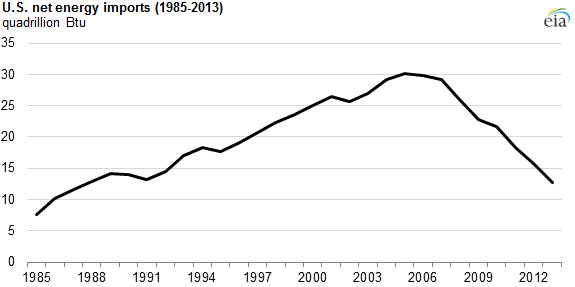
Fracking for natural gas, summary by Madsen Pirie, 10 August 2012.
Almost everything in this short article is wonderful news.
"The world's energy problem seems to have been solved, but governments do not seem to have noticed. A relatively clean and abundant source of energy has not been produced by wind, solar or tidal power, nor even by nuclear power. ... It has been solved by human ingenuity ...
The world has suddenly uncovered vast reserved of natural gas, largely because [of] advances in horizontal drilling and hydraulic fracturing (fracking) technology ... The price of gas in the US has dropped to less than a quarter of its 2008 level
...
Governments which have succumbed to environmental lobbies to subsidize wind farms and solar power generation will find they have unnecessarily increased energy costs to their citizens and their businesses, as well as disfiguring their countrysides.
Gas has the additional advantage that its reserves are not located in politically volatile or hostile parts of the world. It will free the developed countries from dependence on Middle Eastern or Russian energy supplies. The US will soon be self-sufficient in energy ...
Environmentalist organizations will lobby hard against it, citing all kinds of reasons for opposing it, but the main reason is the political one that it does not require changes in our behaviour, or the requirement to live more simply.".
What a great future!
That will really drive the greens mad - if we don't have to change our behaviour!
It will solve the War on Terror too.
While in general I want everyone in the world to be rich, it will be a much safer world
if the oil lottery winners of
the Gulf states and Iran
fall back into
poverty and irrelevance, and become backwaters
again.
The optimistic alternative to green socialism and poverty
is that we use our fantastic science and technology
to make the entire world rich like us, while preserving (and even improving) the planet.
Hat tip
John Connolly.
Possibly invented
here.
Bill Whittle
points out that capitalist countries keep the local environment clean
precisely because they are profit-driven.
Who wants to shop in a smoggy city?
Who wants to buy a house or invest in a town where the water is polluted?
America is now a pretty clean place.
It is socialist and statist countries
like China
that don't care about the environment.
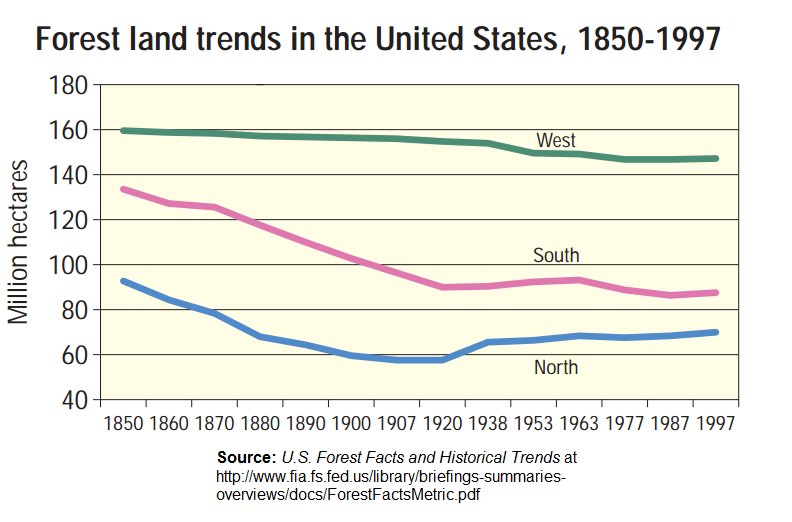
In capitalist America,
deforestation
is over.
The forest cover is the same or bigger than 100 years ago.
From here.
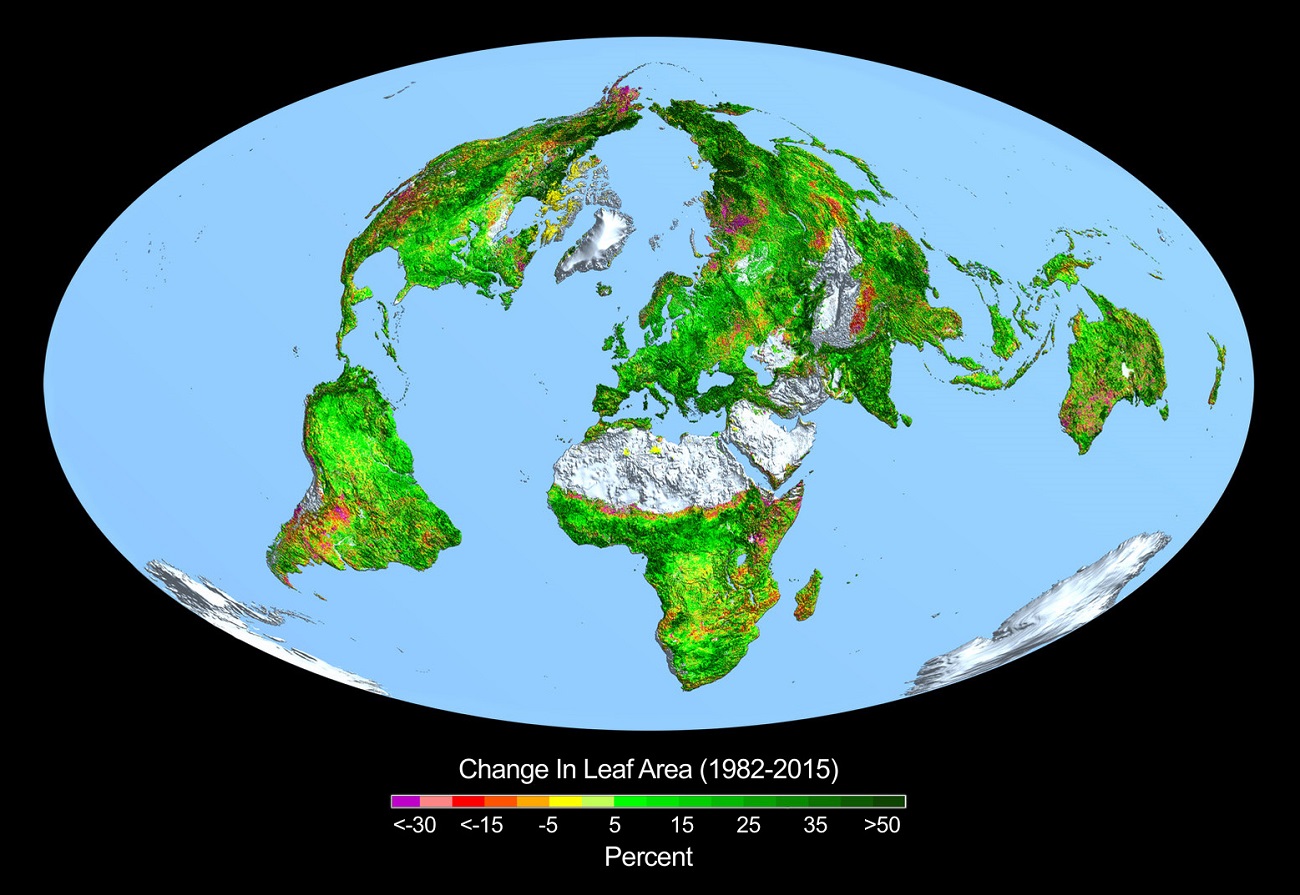
Once countries reach a certain level of economic development, forests begin to rebound.
From here.
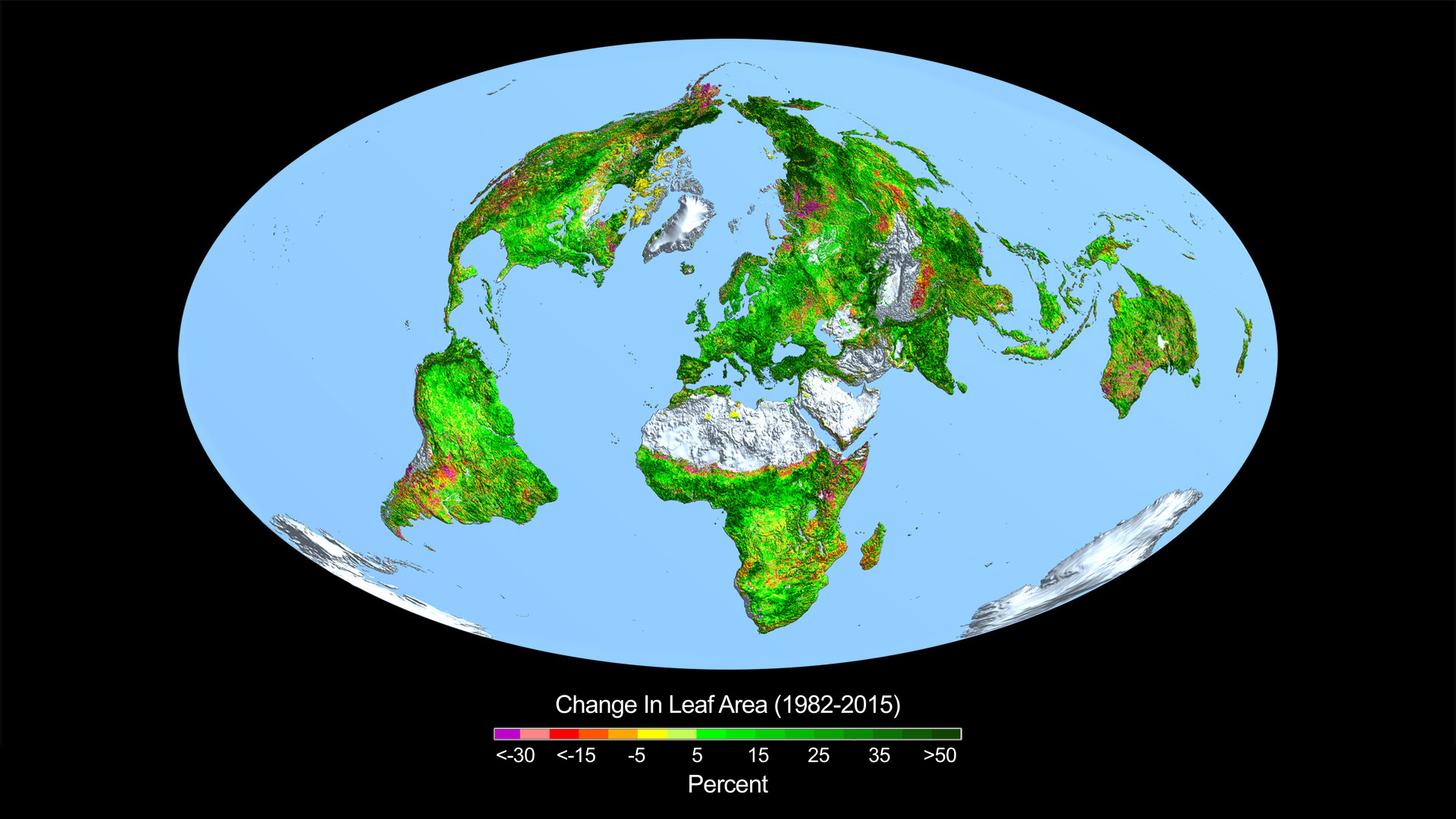
Change in leaf cover over the planet's vegetated regions from 1982 to 2015.
See full size.
From NASA.
Also here.
Theodore Dalrymple
has a nice line on how green theory is both
incredibly speculative (with a weak track record so far of successful predictions)
and yet incredibly arrogant (it almost wants its critics banned or
prosecuted):
"though Monbiot
says that it is uncertain that anything we do now will make any difference, he nevertheless proposes that every human being on the earth follow his prescriptions."
 argues that global warming is happening,
but is probably not the end of the world,
and we can deal with it through science, technology and reason.
argues that global warming is happening,
but is probably not the end of the world,
and we can deal with it through science, technology and reason.